
The evolution of consciousness
If consciousness is a biological phenomenon, how and why did it evolve?
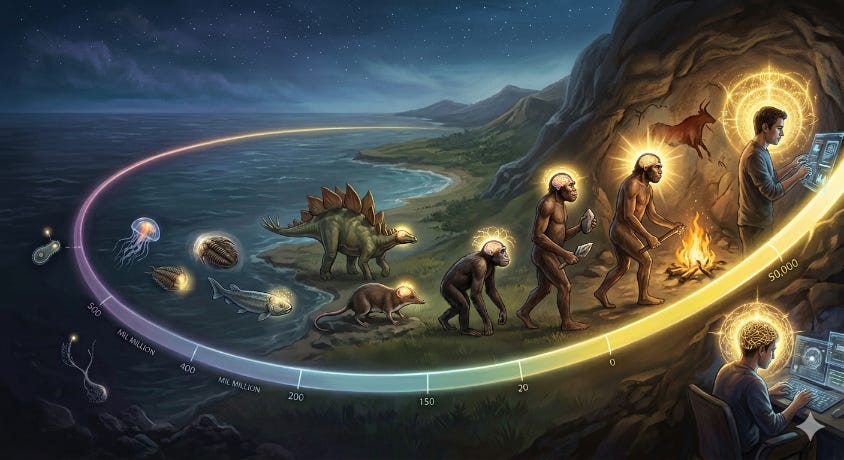
“Consciousness is very difficult to define,” you hear from people who have a vested interest in keeping mysteries alive, or are simply inclined to favor mystery over explanation because of their personality. I don’t think it’s that hard to arrive at decent, operational definitions of consciousness, so here are two, meant to get this discussion going:
Consciousness is the state of being aware of and responsive to one’s surroundings. It encompasses the quality of subjective experience — the “what it is like” to be a particular entity at a particular time. Self-consciousness is a higher-order form of consciousness that involves awareness of oneself as a distinct entity separate from the environment and other beings.
Now, as an evolutionary biologist, I’m inclined to believe that consciousness and self-consciousness — being complex attributes of that very metabolically expensive human organ known as the brain — must evolved for adaptive reasons, just like other functional attributes of the human animal, like breathing or pumping blood.
This is important because a large number of people who reject physicalist interpretations of consciousness (see here and here) are married to the intuition that consciousness couldn’t possibly have evolved because it has no adaptive value. That intuition, however, is increasingly hard to defend. Indeed, most evolutionary biologists and philosophers of mind who take evolution seriously hold that consciousness — or at least its core functional properties — confers genuine selective advantages.
Current thinking, reflected in the Cambridge Declaration on Consciousness (2012) signed by a prominent group of neuroscientists, is that the neural substrates supporting conscious states are not unique to humans. Birds, mammals, and possibly some invertebrates (cephalopods in particular) show behavioral and neurological markers consistent with conscious experience. This fits the physicalist picture nicely: consciousness evolves gradually, its complexity tracks nervous system complexity, and its distribution across phylogeny follows the logic of natural selection rather than any sharp metaphysical boundary.
That said, we are still at the beginning of research on the evolution of consciousness, so a number of hypotheses have been proposed, and it is not, at the moment, clear which one, if any, will be the eventual winner. This is not at all unusual in science or in biology. We have multiple theories, but no consensus on, how life originated on Earth. The same goes for the question of the evolution of human intelligence, which is at least conceptually distinct from that of consciousness. And we don’t have an established theory of cultural evolution.
Still, it’s well worth our time, I think, to take a quick look at four of the major proposals in the field, as partial inoculation against mysterianism and the varieties of non-physicalism. So, here we go.
Global Workspace Theory (Baars; Dehaene & Changeux)
Bernard Baars introduced Global Workspace Theory (GWT) in his 1988 book A Cognitive Theory of Consciousness, drawing on an analogy from cognitive architecture: the mind is organized as a collection of specialized, largely unconscious processors — for vision, language, motor control, memory retrieval, and so on — that normally operate in parallel and in isolation. Consciousness, on this view, is what happens when information is “broadcast” from a local processor into a global workspace, making it simultaneously available to the full range of other processors. Think of it as the difference between a private conversation in one department of a large organization and an all-hands announcement: the latter mobilizes resources across the whole system.
Stanislas Dehaene and Jean-Pierre Changeux translated GWT into a concrete neural hypothesis — the neuronal global workspace — with testable predictions. On their account, the global workspace corresponds to a distributed network of neurons with long-range axonal connections, particularly in the prefrontal and parietal cortices, that can sustain and broadcast activity widely across the brain. Unconscious processing involves local, transient neural activation; conscious access involves ignition of this long-range network, producing the sustained, synchronized activity detectable in EEG and fMRI studies. Crucially, Dehaene’s lab has produced substantial experimental support: using masking and inattentional blindness paradigms, they’ve shown that stimuli processed unconsciously produce local activation, while the same stimuli consciously perceived trigger a sudden, widespread “ignition” across frontal and parietal regions.
The adaptive advantage GWT proposes is cognitive flexibility. Specialized processors are fast and efficient but inflexible — they solve the problems they evolved to solve and nothing else. A global workspace allows the organism to route information from any one module to any other, enabling novel combinations and genuinely creative responses to unprecedented situations. This matters most in unpredictable, complex environments — precisely the environments that drove the evolution of large brains in primates and corvids. An organism with a global workspace can, for instance, recruit spatial memory to solve a social problem, or use language to regulate emotion — cross-domain operations that a purely modular system cannot perform. GWT also explains why conscious processing is slow and serial compared to unconscious processing: broadcasting is metabolically expensive and capacity-limited, so the workspace acts as a bottleneck, allocating attentional resources to whatever is most relevant at a given moment.
GWT is arguably the best-supported theory in terms of experimental neuroscience, and it makes genuinely falsifiable predictions. Its main limitation, acknowledged by Baars and Dehaene themselves, is that it is primarily a theory of access consciousness — of what information becomes globally available — rather than of phenomenal consciousness, of why that access feels like anything at all. Critics argue that GWT explains the “easy problems” of consciousness while leaving the hard problem untouched. Dehaene’s response is essentially deflationary: once you’ve explained access consciousness fully, there may be nothing left to explain.
Predictive Processing / Active Inference (Friston; Seth; Clark)
The predictive processing (PP) framework, developed most formally by Karl Friston and elaborated philosophically by Andy Clark and Anil Seth, proposes that the brain is not primarily a passive receiver of sensory information but an active prediction machine. At every level of the neural hierarchy, the brain generates predictions about incoming signals and sends these predictions downward; only the error between prediction and actual input travels upward for correction. Perception, on this view, is a form of controlled hallucination — the brain’s best guess about the causes of its sensory inputs, constrained (but not determined) by the actual signals arriving from the world.
Anil Seth’s contribution, developed extensively in his 2021 book Being You, is to apply this framework specifically to consciousness. Phenomenal experience, Seth argues, is the content of the brain’s generative model — not a passive recording of reality but an actively constructed representation. The “redness” of red, the painfulness of pain, the sense of being a bounded self in a world of objects — all of these are predictions, the brain’s best hypotheses about what is causing its sensory states. The self, in particular, is a predictive model of the organism as an agent: a set of predictions about the body’s states (interoception), its position in the world, and its causal powers.
The adaptive value here is accurate self-modeling for action. An organism that has a rich, updatable model of its own internal states — hunger, fatigue, arousal, pain — and of its own capacities and limitations can regulate its behavior far more effectively than one that lacks such a model. Interoceptive consciousness (awareness of bodily states) is particularly important: emotions, on Seth’s account, are predictions about the body’s physiological condition, and they motivate adaptive behavior by representing what the organism needs. The framework also connects naturally to active inferenc* — Friston’s more formal account of how organisms minimize “free energy” (roughly, prediction error) by either updating their models or acting on the world to bring it into line with predictions. Consciousness, on this view, is the subjective face of a system that evolved to keep the organism’s predictions about itself and its environment as accurate as possible.
PP is intellectually ambitious and has achieved impressive unification across perception, action, emotion, and psychopathology (hallucinations, for instance, are naturally interpreted as runaway prediction errors). Seth’s account is also notable for taking the biological basis of consciousness seriously in a way that some purely computational theories don’t: he emphasizes that consciousness is rooted in the body’s physiological needs, not just in abstract information processing. The main criticisms are that the framework is sometimes accused of being too flexible — almost anything can be redescribed in predictive processing terms — and that, like GWT, it may explain the functional architecture of consciousness without fully addressing why that architecture is accompanied by phenomenal experience.
Social Brain / Theory of Mind Hypothesis (Humphrey; Dunbar)
Nicholas Humphrey’s hypothesis, first sketched in his 1976 essay “The Social Function of Intellect” and developed in books including A History of the Mind (1992) and Soul Dust (2011), is that consciousness evolved not primarily to deal with the physical environment but to deal with other minds. The core problem facing a social animal is understanding and predicting the behavior of conspecifics — creatures who, unlike rocks and trees, have beliefs, desires, intentions, and emotions that are not directly observable. Humphrey’s key insight is that the most reliable way to model another mind is to use your own mind as a template: to simulate, from the inside, what it would feel like to be in the other’s situation. This requires having a rich inner life in the first place — consciousness, on this view, is the instrument that makes social intelligence possible.
Robin Dunbar approached the same problem from a different angle, through his work on the relationship between neocortex size and social group complexity across primates. His “social brain hypothesis” holds that the cognitive demands of tracking relationships, alliances, and reputations in large social groups drove the expansion of the primate neocortex — and, by extension, the elaboration of conscious social cognition. Humans, with our extraordinarily large neocortices relative to body size and our social groups of up to ~150 stable relationships (Dunbar’s number), represent the extreme of this trend. The capacity for “theory of mind” — attributing mental states to others — is measurably correlated with neocortex volume across species.
What makes Humphrey’s account specifically about phenomenal consciousness, rather than just social cognition in general, is the argument that the felt quality of experience is precisely what enables simulation. To predict how another animal will respond to pain, it helps enormously to know what pain feels like — to be able to run an internal simulation that captures not just the behavioral output but the motivational and affective structure of the experience. Consciousness, on this view, is evolution’s solution to the problem of opacity: other minds are not directly observable, but one’s own mind is, and that introspective access serves as the foundation for interpersonal understanding.
This hypothesis has considerable explanatory power for the social dimensions of human consciousness — empathy, moral emotion, narrative self-understanding, the capacity for deception and its detection. It also connects naturally to the literature on autism spectrum conditions, where theory-of-mind deficits co-occur with altered phenomenal experience in ways the hypothesis would predict. Its main limitation is that it doesn’t straightforwardly explain aspects of consciousness that seem independent of social function — aesthetic experience, for instance, or the felt quality of physical pain in solitary organisms. Humphrey himself has extended the account in various ways to handle these cases, but critics find the extensions strained.
Temporal Integration and Mental Time Travel (Tulving; Suddendorf & Corballis)
Endel Tulving’s distinction between semantic memor* (general knowledge) and episodic memory (memory for specific personally experienced events) proved foundational for this line of research. Episodic memory is not merely storage of past events: it involves mentally re-experiencing them, traveling back in time subjectively and re-living the event from the inside. Tulving’s further claim — controversial at first but now widely accepted — is that the same cognitive system that supports episodic memory also supports prospection: the capacity to imagine specific future events, to mentally simulate scenarios that have not yet occurred. He called this capacity “mental time travel” or chronesthesia — the subjective sense of time extending in both directions from the present moment.
Suddendorf and Corballis elaborated the evolutionary implications in a highly influential 2007 paper and subsequent book. Their argument is that mental time travel — the capacity to simulate specific past and future episodes — confers an enormous adaptive advantage: it allows organisms to prepare for anticipated future needs rather than merely responding to current states. An animal that can imagine next winter’s food scarcity and begin hoarding now, or that can simulate the likely consequences of a planned action before executing it, is at a significant selective advantage over one confined to the present. They also argued, more controversially, that this capacity is uniquely or near-uniquely human — a claim that has been substantially challenged by subsequent work on corvids, great apes, and other species showing behavioral signatures of future planning.
The connection to consciousness is that episodic memory and prospection are paradigmatically conscious processes — they involve the felt sense of “remembering” and “imagining,” the subjective quality of mentally inhabiting a past or future scene. The binding of events into a coherent temporal narrative — the sense of being a self that persists through time with a past and a future — is one of the most distinctive features of human conscious experience, and on this account it is precisely that feature that evolution selected for. A creature without phenomenal temporal integration might respond to current stimuli and run behavioral routines, but it could not plan, regret, anticipate, or learn from episodic memory in the rich sense that adaptive success in complex environments requires.
The neuroscience here is striking: the same network of brain regions — the hippocampus, medial prefrontal cortex, posterior cingulate, and angular gyrus, collectively the “default mode network” — is active both during episodic recall and during future simulation. Patients with hippocampal damage lose not only the ability to form new episodic memories but also the ability to imagine coherent future scenarios, suggesting that the same constructive machinery underlies both capacities. This “scene construction” network is also active during fictive thinking more broadly — whenever the mind constructs a coherent imagined scenario, past, future, or counterfactual.
This account is well-supported neurologically and behaviorally and has the advantage of linking consciousness to a specific, well-characterized cognitive system with clear adaptive benefits. It also connects naturally to the evolution of language (which enormously amplifies the capacity for temporal narrative) and to distinctively human phenomena like regret, anticipation, hope, and long-term planning. Its main limitation is that it focuses primarily on the narrative and temporal dimensions of consciousness, and has less to say about basic perceptual or affective consciousness — the kind that presumably predates episodic memory in evolutionary history and that we share with species whose temporal cognition is much simpler than ours.
So, where are we?
These four accounts are not mutually exclusive — and most researchers in the field treat them as complementary rather than competing. A plausible integrated picture would be something like this: basic phenomenal consciousness (the capacity for experience) evolved early, grounded in interoceptive and perceptual systems that gave organisms better models of their own states and environments (predictive processing).
Global workspace mechanisms then elaborated this into flexible, cross-domain cognitive integration. Social complexity drove further elaboration of self-modeling as a basis for other-modeling (theory of mind).
And the temporal dimension of consciousness — the binding of experience into a narrative self extended through time — represents a relatively late elaboration that dramatically expanded the adaptive scope of conscious cognition.
The result, in our species, is the extraordinarily rich, socially embedded, temporally extended form of consciousness that makes us, among other things, capable of arguing about whether consciousness is physical.
_____
Post-scriptum: Why did I not include Integrative Information Theory (IIT, Tononi) in this survey? Because it doesn’t actually fit the essay’s organizing question. The four theories I discuss each offer an account of why consciousness evolved — what selective pressure drove it, what adaptive problem it solves. IIT is instead a theory of what consciousness is and where it exists (any system with sufficient integrated information). It’s a structural/metaphysical claim, not an evolutionary one.
There’s also a second reason worth being candid about: IIT has taken serious hits recently. A 2023 open letter signed by over 100 neuroscientists — including people with impeccable credentials — called it pseudoscience, specifically because its core claims are structured to resist empirical falsification.
And third: IIT’s panpsychist implications — that thermostats and logic gate arrays have some minimal consciousness — cuts against the evolutionary framing entirely.
Thank you for a wonderful conversation — it really helped clarify my thinking. I’ve always believed that consciousness must have some divine explanation, something that goes far beyond the basic biological drives of eating, reproducing, and surviving. But this discussion opened my eyes to other possibilities, and in doing so, it deepened the mystery rather than resolved it. It was, in every sense, a moment of genuine growth
Massimo, my beginner's question: Is it correct that E. O. Wilson's ideas provide a meta-view of the four hypotheses you laid out?
He posited that consciousness evolved because it improved the survival and reproductive success of highly social organisms, and ultimately arises from physical processes in the brain shaped over millions of years. He argues that it's an adaptive product of brain evolution that helped organisms model their environment, anticipate dangers, navigate social relationships, and coordinate group living. The correlates of this are self-awareness and symbolic thought which give humans exceptional abilities for culture, morality, planning, and collective problem-solving.