
Physicalism and consciousness — part I
What physicalism is, why the evidence supports it, and why the alternatives fail
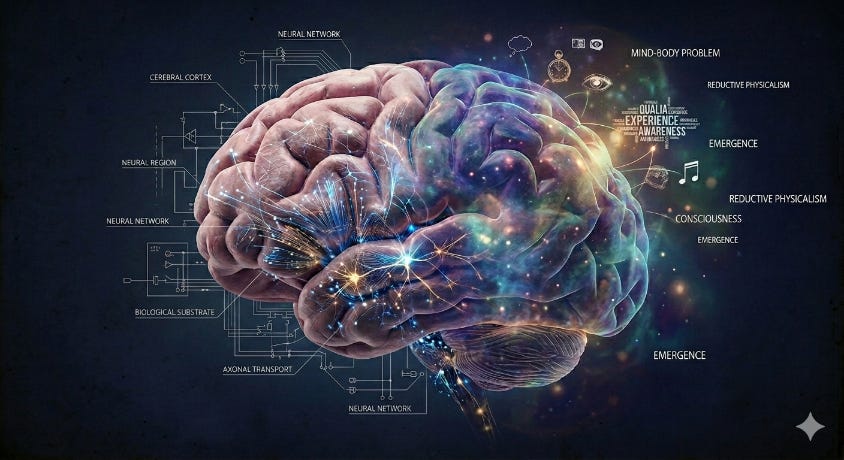
Recently I was at a party with a number of smart friends from different disciplines. One is a space engineer, another a software engineer, the third one a philosopher of science with an incredible grasp of both general relativity and quantum mechanics. And yet, to my bafflement and surprise (and, I have to admit, a bit of irritation!), they were all skeptical of physical explanations of consciousness. What was going on?
Actually, resistance to physicalism — the technical philosophical term for what I’m about to discuss in this essay — runs deep even among the intellectually sophisticated. It is, therefore, interesting to understand why.
Moreover, this isn’t a merely academic dispute. How we answer the question of the nature of consciousness has implications for how we think about medicine, AI, free will, and personal identity.
What I’m going to argue is that physicalism isn’t the lazy default, but rather the position best supported by evidence and most consistent with scientific methodology. So, let’s get started, shall we? I’ve organized the following into a number of short thematic sections, for ease of reading now and possible consultation in the future.
What physicalism actually claims (and what it doesn’t)
First off, let me clarify the thesis: physicalism is the notion that everything that exists, including mental states, is either physical or fully dependent on the physical.
Physicalism comes in varieties (reductive, non-reductive, eliminativist) — and it’s important not to conflate them. For instance, we need to distinguish physicalism from what is referred to in philosophy of mind as “eliminativism,” which is the notion that folk psychology is wrong in important ways.
As an example, take the concept of belief. We routinely explain behavior by saying someone “believes” something — for instance, “Maria believes it will rain, so she brought an umbrella.” Folk psychology treats beliefs as discrete, propositional mental states that causally influence behavior. Eliminativists like Paul and Patricia Churchland argue that beliefs don’t exist as folk psychology describes them, because beliefs don’t have neural correlates, don’t really explain much, and are characterized by severe predictive limitations. I am not an eliminativist, even though I agree that at least some folk psychological concepts are misleading or even entirely incorrect.
Another distinction to be made is between physicalism and naïve reductionism, the notion that consciousness just equals the firing of neurons, full stop. I don’t know whether anyone actually holds to such a crude “explanation” of consciousness, but I ain’t one of them.
This may also be a good place to pre-empt a common strawman: physicalism doesn’t deny that consciousness is real, phenomenologically rich, or philosophically interesting. It is indeed all of that. What physicalism denies is that consciousness requires non-physical ingredients.
The evidential case for physicalism
There are at least five lines of evidence in favor of the notion of physicalism. First, decades of research in neurobiology have uncovered a large number of neural correlates of consciousness. Every mental state we’ve examined — and we’ve examined a lot of ‘em! — has a physical correlate, meaning an area of the brain that seems to be causally linked to it. It is by now very well established that damage to specific brain regions produces specific, predictable changes in experience.
For instance, when you consciously see a stimulus (like a face or a letter), specific measurable patterns of neural activity occur in the back of the brain. Researchers use techniques like binocular rivalry or masking to study this. In binocular rivalry, they show a different image to each eye (e.g., a house to the left eye, a face to the right): even though the physical input to the eyes is constant, the subject’s conscious perception flips back and forth between the two.
Neuroscientists like Christof Koch and Giulio Tononi have observed that when someone reports seeing the face, neurons in the fusiform “face area” (part of the temporal lobe) fire vigorously. When the subject reports seeing the house, neurons in the parahippocampal “place area” fire instead. Crucially, the activity in these posterior regions correlates tightly with what people are consciously experiencing, not just with light hitting the retina.
Second, consider the pharmacology of psychedelics: specific molecules alter consciousness in lawful (meaning, scientifically repeatable), dose-dependent ways. If the mind were non-physical, why would serotonin receptor agonists reliably produce “mystical” experiences?
Third, consciousness, like any other biological phenomenon, shows evolutionary continuity: consciousness appears to emerge gradually across phylogeny, which is what we would expect if it were a physical process. There’s no obvious place to insert a non-physical “soul” or anything else without arbitrary line-drawing.
Fourth, we also know quite a bit about the developmental trajectory of consciousness. The sophistication of the mind tracks brain development in children — as well as its deterioration in dementia, anesthesia, and brain injury. Again, all of this is precisely what one would anticipate if we were talking about a physical phenomenon.
Finally, we need to consider the causal closure of physics, which states that every physical event has a sufficient physical cause. If something physical happens (like a ball moving, a neuron firing, or your arm rising), there is a complete chain of physical causes leading up to it that stays entirely within the realm of physics. You do not need to invoke non-physical forces (like a soul, a ghost, or a “mind substance”) to explain why a physical event occurred.
If non-physical mental states causally affect the physical world (as they must, if they’re to do anything at all), then physics is causally open — which is in deep tension with literally everything we know from physics and neuroscience.
So, what’s the “hard problem,” then?
The so-called hard problem of consciousness has most famously been publicized by philosopher of mind David Chalmers, ever since he gave a talk back in 1994 to a science of consciousness conference in Tucson, Arizona. The problem concerns how we explain why there is “something it is like” to be in a mental state (for instance, seeing red, or tasting gelato), and it is indeed genuinely difficult, so much so that simply dismissing it out of hand is bad philosophy.
But it is crucial to distinguish between an explanatory gap (which is real, and nobody denies) and an ontological gap (which is the issue at hand). The fact that it is objectively difficult to explain why physical processes give rise to experience doesn’t mean they don’t.
There is an available historical analogy that may make things clearer: vitalism. For a long time life seemed irreducibly non-physical, until it didn’t. The abandonment of vitalism is, in fact, one of the most significant turning points in the entire history of science. Vitalism was the belief that living organisms are fundamentally different from non-living entities because they contain some non-physical element (often called a “vital force,” élan vital, or vis vitalis) or obey different laws than inanimate matter.
Scientists didn’t just “decide” to abandon it: they systematically dismantled it through a combination of experimental breakthroughs and theoretical shifts that showed life could be explained entirely by chemistry and physics. It’s a long and fascinating history, but let me briefly comment on just one episode, the very first blow against vitalism. For centuries, the strongest argument for that notion was the field of organic chemistry. Chemists believed that “organic” compounds (those found in living things, like urea, sugar, or proteins) could only be produced by living organisms under the guidance of a vital force. “Inorganic” compounds (minerals), by contrast, could be synthesized in a lab. In 1828, German chemist Friedrich Wöhler accidentally synthesized urea (a waste product found in urine) from ammonium cyanate, an inorganic salt, thus proving that an organic compound could be created from inorganic materials without any living tissue involved.
Consciousness hasn’t yet had its “urea moment,” so to speak, so the hard problem is certainly a hard scientific problem, but that doesn’t amount to evidence of a metaphysical divide.
Moreover, “I can’t imagine how X could be physical” — which is an oft-repeated “argument” against physicalism, is not evidence that X is non-physical. Arguments from conceivability, which are at the core of Chalmers’s treatment of consciousness (see his infamous p-zombies [https://en.wikipedia.org/wiki/Philosophical_zombie]), are fatally flawed because conceivability (or lack thereof) establishes nothing about how the world works.
The alternatives — and why they fail
A number of philosophical accounts (a term I prefer to the more pretentious and sciency-sounding “theories”) have of course been proposed as alternatives to physicalism. In my judgment, they all fail. Here’s why.
The most popular non-physicalist “explanation” of consciousness, and likely the one that is pre-reflectively assumed by most people who haven’t thought about such matters either scientifically or philosophically, is what is known as substance dualism. Plato’s metaphysics, with its concept of an immaterial and immortal soul, is arguably one of the earliest and most sophisticated versions. (One of the friends I mentioned earlier, who is a Christian, naturally embraces substance dualism.) But so is René Descartes’s account, proposed — rather ironically — at the beginning of the scientific revolution (Descartes was a contemporary of Galileo).
The fundamental problem with substance dualism is that nobody has provided a convincing explanation of how the non-physical mind interacts with the physical brain. Descartes suggested that the key lies in the pineal gland of the brain, which in his time was not known to have any biological function. We now know that the gland produces and secretes melatonin, a hormone that plays a crucial role in regulating circadian rhythms — your body’s internal sleep-wake cycle. At any rate, the “interaction problem” remains unresolved after 400 years (or almost two and a half millennia, if you count from Plato). Incidentally, it also conflicts with causal closure.
A more sophisticated version of the same approach is found in property dualism, the idea that mental properties are ontologically distinct but somehow “attach” themselves to physical substances. David Chalmers is, as far as I can tell, a property dualist, and so are my two engineer friends. While this appears to be more plausible than substance dualism, it still posits entities and / or properties with no detectability and no explanatory work that physicalism can’t do, and so it is at the very least redundant, flagrantly violating the heuristic known as Occam’s Razor.
Third, we have panpsychism, a currently fashionable stance endorsed by philosophers like Philip Goff and Galen Strawson (and, curiously, rejected with a sneer by all three of my friends...). (Here is a good philosophical takedown and here is a scientific one.)
According to panpsychism (which comes in a confusing, I’d say obfuscatory, variety of forms) consciousness is fundamental and ubiquitous, a basic property of matter, whatever that actually means. The strongest objection against panpsychism is the combination problem: how do micro-experiences (say, in every atom and molecule that constitutes an object) combine into unified human consciousness? This is arguably harder than the “hard problem” itself, not to mention that panpsychism is, again, empirically idle.
Finally, we have idealism, another notion that has been around for a while but is becoming surprisingly popular. According to idealists like Bernardo Kastrup, everything is mental and experiential, not physical. This is (once more!) an entirely unfalsifiable notion and hence ought to be regarded, as physicist Wolfgang Pauli memorably put it, as “not even wrong.” Idealism collapses into a view that basically says that the world behaves exactly as if physicalism were true, which is not a point in its favor.
All in all, the proposed alternatives don’t actually solve anything, let alone the hard problem which motivated them in the first place. They simply rename the problem or relocate it, ending up into much talk and no substance.
[Next time: Why people resist physicalism and answers to some common objections to it.]
Wonderful piece, Massimo. Your broad knowledge and various details are welcome as I'm a rank amateur in both philosophy and science. I've propounded physicalism (along with denying will free of physical causes) for around 1/4C. Recall that a few years ago I initiated a short three way with Dan Dennett and you on the latter point. Dennett's Compatibilism struck me as inconsistent with his physicalism. He never relented, although I challenged him.
I was unaware of Galen Strawson's panpsychism, as my only exposure to him focussed on free will, which he denies. https://www.informationphilosopher.com/solutions/philosophers/strawsong/
I eagerly await part 2.
Steve Kurtz
As a property dualist, I challenge your statement that property dualism "posits entities and / or properties with no detectability and no explanatory work that physicalism can’t do, and so it is at the very least redundant".
The distinction between substance dualism and property dualism is implicit in Aristotle's critique of Plato's view of the Forms. Aristotle proclaimed that the Forms do not exist apart from things.
Although you are skeptical of metaphysical approaches to ontology and physicality, I have found this approach useful. I wrote up a long paper that manifests Aristotle's view of the forms in the physical processes of Quantum Mechanics. This analysis led me (unwillingly) to a pan-proto-psychism similar to that of Chalmers. See "Hylomorphic Functions": https://researchers.one/articles/18.11.00009
This paper is not peer-reviewed (which immediately discounts it), since I moved on to other subjects. But the first third of the paper has actually been published in a peer-reviewed journal as "Causally Active Metaphysical Realism". As you can see by the title, I anticipate objections such as yours and demonstrate that abstract concepts (the Forms that Aristotle discusses) are real and that they cause things to happen. Therefore they are detectable and are the explanation of things and events in this world. I even end the paper with a series of testable experiments. One nice property of my theory is that it relativizes naturally.
Collapsed into a sentence, my thesis is that the physical world is the Schrodinger Wave Equation, but the collapse of the wave function is the generation of an abstract concept - a Fact that is the instantiation of a Form (what I call a Hylomorphic Function).
Causally Active Metaphysical Realism
Quantum Speculations (supplement to the International Journal of Quantum Foundations), Volume 1, Number 1, October 2019, Pages 1-31.
https://ijqf.org/archives/5704