
On self-determination and the limits of pacifism
Why Taiwan and Ukraine are not the same as Scotland and the Basque Country
A friend recently pointed out what he took to be a contradiction in my political views. I favor Taiwan’s independence from China and support Ukraine’s right to resist Russian annexation of its eastern regions, but I am a bit skeptical about, say, the Basque Country separating from Spain or Scotland leaving the United Kingdom. Isn’t this inconsistent? Do I believe in the right of people to self-determination, or don’t I?
It’s a fair challenge, and it deserves a careful answer. But as I’ll argue, the apparent contradiction dissolves once you notice that these cases differ in almost every morally relevant way. More interestingly, working through the differences forces us to confront a deeper question: what, exactly, are we committed to when we invoke “self-determination” as a political value? And what should we make of the principled pacifist position, which is my friend’s view, that the avoidance of war should override everything else?
Let’s start with Taiwan. It has functioned as a fully independent democratic state since 1949. It has its own military, its own currency, its own constitution, and a government chosen through free elections. Nevertheless, at the moment of this writing, only 11 countries and the Vatican officially recognize Taiwan as a sovereign nation, though another 28 (including most European countries, Canada, and the United States) consider the status of Taiwan to be “unsettled.”
The question in the Taiwan Strait is not really “should Taiwan separate from China?,” since it was never part of the People’s Republic of China to begin with (the two nations were established at the same time). The real question is whether China should be permitted to forcibly absorb a functioning democracy against the will of its population. My intuition here is driven less by abstract self-determination and more by opposition to aggressive annexation of a democratic polity by an authoritarian one.
Consider now Donbas – the Donetsk and Luhansk regions of eastern Ukraine. This is different in almost every relevant dimension. The “self-determination” invoked there was manufactured through Russian military intervention, fought by irregular forces operating alongside Russian regulars, and ratified by referenda conducted under occupation, with populations displaced and independent observation impossible. Whatever genuine Russophone cultural identity existed in those regions, and it did exist, it was cynically weaponized as a pretext for territorial expansion and the will of the people was never freely expressed. In my opinion, this is much closer to a fabricated legitimacy crisis than a genuine independence movement.
What about Scotland and the Basque Country? These are harder cases, but for different reasons. Both involve genuine cultural and linguistic minorities within democratic states, with real and longstanding popular sentiment for independence. Here there is no annexation, no occupying army, no manufactured referendum. The question is purely one of constitutional self-determination within a functioning liberal democracy.
In terms of the philosophical reasoning underlying my positions, when I defend Taiwan and Ukraine, I am not relying on a single principle but on three converging considerations, weighted differently depending on the case.
The first is democratic self-determination. Peoples have a claim to govern themselves, especially when they have demonstrated a stable political identity over time. This applies with some force to all four cases, though more strongly to some than others.
The second is resistance to violent annexation. There is a strong moral presumption, which I take to be close to a threshold condition, against allowing one state to forcibly absorb another’s territory, especially through military means. This consideration is decisive in the Taiwan and Ukraine cases. It is essentially irrelevant to Scotland and the Basque Country, since neither the UK nor Spain is attempting to annex anyone by force.
The third is the consequences of appeasement. History gives us strong empirical reasons to believe that consistently rewarding aggressive territorial expansion produces more aggression, not less. The lesson of the 1930s – Rhineland, Austria, Sudetenland, Prague – is that each concession made the next demand more likely, not less. This argument does most of its work in the Taiwan and Ukraine cases, where an external power is making coercive demands. It does very little work in the Scottish or Basque contexts.
Notice what follows from applying these three considerations differently weighted across cases. Taiwan and Ukraine trigger all three, and the annexation argument alone is nearly decisive, I think. Scotland and the Basque Country trigger only the first, and in a weaker form, since the relevant question is not resistance to aggression but whether democratic aspirations should be accommodated through negotiation and referendum. The framework isn’t producing inconsistent verdicts, it’s doing exactly what a multi-consideration framework should do: generating different conclusions because the cases genuinely differ.
I do have sympathy for the wishes of both the Scots and the Basque, who have indeed suffered oppression historically. But I’m also in favor of a strong and unified Europe (despite the highly unfortunate Brexit episode), because I think it needs to play the role of counterbalancing superpower in the wake of oppressive Russia and China and an increasingly unhinged (and never really liberal-democratic) United States.
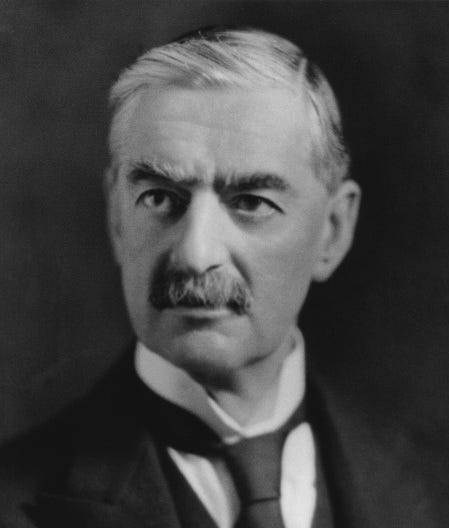
So much for my opinions on the matter. My friend’s position is different in kind. His overriding principle is the avoidance of war, and to his credit, he follows it consistently: if China wants Taiwan and Russia wants Donbas, and letting them have these territories prevents armed conflict, then that is what should happen. Neville Chamberlain, he might note, was not stupid or cowardly. He had vivid memories of the First World War, with seventeen million dead, and believed sincerely that peace was worth almost any price.
This is a philosophically serious position, and I don’t want to dismiss it with cheap rhetoric about Munich. But it faces several objections that I find, in the end, decisive.
The first is structural. A consistent policy of giving aggressors what they want to avoid war creates a powerful incentive for future aggression. The more reliably the international community capitulates, the more attractive territorial expansion becomes for states willing to threaten force. The long-run consequence of principled appeasement is likely more wars, not fewer, because you are deferring and compounding the violence rather than preventing it. This is not idle speculation: it is roughly what the historical record of the interwar period shows.
The second objection is about whose preferences count. My friend’s principle effectively privileges the preferences of whichever party is most willing to use violence. Taiwan doesn’t want war any more than China does. Ukraine doesn’t want war any more than Russia does. Why does the aggressor’s readiness to make war override the defender’s right not to be conquered? A genuine anti-war principle should be symmetrical. As stated, it systematically favors whoever has more military power and fewer moral scruples.
The third objection is about what we mean by peace. Life under occupation or authoritarian annexation is not peace in any meaningful sense. It involves suppression of political dissent, imprisonment of activists, erasure of language and culture, and often systematic violence that simply doesn’t register as “war” in the conventional sense. We have a vivid example in the Uyghur population of Xinjiang: no open warfare, enormous suffering. A moral framework that counts only battlefield deaths as violence is quietly doing a great deal of work that deserves to be made explicit and scrutinized.
Finally, the argument proves too much. Taken to its logical conclusion, my friend’s principle would have required the Allied powers not to resist Hitler after the fall of Poland, or France, or even after the invasion of the Soviet Union, since resistance meant war. Almost no one actually bites that bullet, and the fact is that we don’t suggest that the avoidance of war, however important, should be the sole supreme value in political morality.
I should be fair to my friend’s position by presenting its most sophisticated form. The strongest version of the anti-escalation argument does not deny any of the above. It says, rather, that modern warfare involving nuclear-armed great powers introduces a category of risk that changes the calculus in ways that conventional moral principles cannot fully capture. Even a small probability of nuclear exchange should dominate expected-value calculations given the catastrophic nature of the outcome. Taiwan, in particular, sits at the intersection of Chinese territorial claims and American security commitments (pre-Trump, of course), with China’s growing nuclear arsenal in the background. The tail risk here is not negligible.
This is a good argument. I think those of us who support robust defense of Taiwan and Ukraine are obligated to take it seriously rather than waving it away. The response, I believe, is not to dismiss the risk but to argue that consistent deterrence, demonstrating that aggression will be costly, is itself the best long-run strategy for reducing the probability of catastrophic conflict. A world in which democracies credibly resist annexation is less likely to produce the kind of unconstrained revisionist behavior that eventually makes great-power war unavoidable. But this is an empirical argument, and reasonable people can weigh the probabilities differently.
Returning to the cases that generated my friend’s original challenge: I am prepared to accept that my framework yields a genuinely more sympathetic verdict on Scottish and Basque aspirations than a simple “territorial integrity” principle would. Democratic self-determination, taken seriously, does give some weight to the expressed preferences of cultural and linguistic minorities within democratic states, especially when those preferences are strong and longstanding.
But it matters enormously how those aspirations are pursued. Scotland held a legal independence referendum in 2014, negotiated with Westminster, and the result – 55% to remain – was accepted by both sides. That is precisely the right model: peaceful, democratic, and legitimate within the constitutional framework of the host state. The Basque Country has been denied an equivalent process by Madrid, which is a real grievance. But even there, the appropriate remedy is democratic pressure and constitutional negotiation, not the kind of resistance that would be warranted against military annexation.
The key point is that without the annexation and appeasement considerations doing any work, democratic self-determination alone is a weaker and more procedural value. It says: these aspirations deserve to be heard, and referenda should not be indefinitely blocked. It does not say: these regions are entitled to independence regardless of the outcome of democratic processes.
There is something clarifying about laying all of this out explicitly, for which I sincerely thank my friend, who engaged with me on these topics over a delicious dinner in Turin. The original charge of inconsistency rested on the assumption that “self-determination” is a single principle applied uniformly. But moral and political reasoning rarely works that way, and when it does, the results are usually worse, not better, than reasoning from multiple considerations that track the genuine complexity of particular cases.
What I am committed to, in the end, is something like this: legitimate political change requires a freely expressed democratic will, pursued without military coercion, through processes that the relevant parties recognize as legitimate. That principle generates different verdicts across different cases not because it is being applied inconsistently, but because the cases themselves differ in ways that matter morally.
My friend’s single-principle pacifism has the virtue of consistency and the vice of insensitivity to everything that principle rides roughshod over. My multi-consideration approach has the virtue of tracking real moral complexity and the vice of requiring ongoing judgment about how to weigh competing values. I’ll take the second set of trade-offs. Judgment, as Cicero would remind us, is not a weakness in moral reasoning, it is its highest expression.
Writing from Hong Kong, I read your framework carefully and want to push on two moves before I develop the argument further in a longer piece.
The first is a silence rather than a claim. You dismiss Russia's Donbas rhetoric explicitly — the "Russophone cultural identity" was real but "cynically weaponized as a pretext for territorial expansion." Fair. But when you turn to Taiwan, the entire rhetorical foundation of the PRC's claim — the "自古以來" or "since ancient times" historical-continuity argument — never enters your framework. You handle the Taiwan case through statehood and annexation-resistance alone, as if the historical-continuity story simply weren't part of the discourse. It is the discourse. Refusing to engage it is a stance, not a neutral omission. Either you think historical-continuity claims deserve no analytical weight (in which case that meta-principle needs its own defense, since it's doing a lot of work), or you find them beneath serious treatment (which is a rhetorical choice, not an argument). Making that choice explicit would strengthen the framework rather than weaken it.
The second is structural. Your three considerations are all — quite reasonably, given the cases at hand — oriented against forced absorption. Democratic self-determination, resistance to violent annexation, consequences of appeasement. Each one triggers against something. But this means the framework has no room to bless a voluntary merger even when the conditions for one look philosophically respectable: mutual consent through legitimate procedures, plausible efficiency gains, meaningful cultural proximity. A hypothetical deepening of EU integration, or a Nordic political union, would sit awkwardly in your framework — not because it should be opposed, but because your considerations only speak when something is being resisted. Merger is not intrinsically illegitimate; annexation is. The morally relevant difference is the consent mechanism plus whether efficiency and cultural conditions genuinely obtain. A framework that cannot articulate the positive case for voluntary union is missing something structural, not just a case.
Two further considerations I couldn't fit into a comment — the labor stock of independent development (why post-independence accumulated stock cannot be morally shared with a non-contributing polity through retroactive historical claim), and the reversibility of secession (why decisions of that magnitude should be treated more like marriage-with-prenup than divorce) — I'm developing in a longer essay. Curious whether you'd read the six-consideration extension as friendly refinement or a challenge to the underlying framework.
Your analysis of independence movements is flawed by a very short historical timeframe. I am glad to see that, in the case of Taiwan, Percy Chan Chi Wo brought up the matter of "since ancient times." History is measured in centuries, not decades. I cannot speak to the matter of the Basques, but since I am of Scots descent on both my parents' side (my father can trace his lineage back to the 900s from a Norseman converted to Christianity who lived in the Orkneys) I can better speak to that. Your dismissal of the "resistance to violent annexation" just does not apply to the Scots.
https://en.wikipedia.org/wiki/Kingdom_of_Scotland
They were fighting to preserve their independence from England around 1300, at least.
https://en.wikipedia.org/wiki/William_Wallace
https://en.wikipedia.org/wiki/Robert_the_Bruce
This went on for centuries. Bonnie Prince Charlie was one of the leaders of the Jacobin revolution in the mid 1750s
https://en.wikipedia.org/wiki/Charles_Edward_Stuart
https://en.wikipedia.org/wiki/Jacobite_rising_of_1745
I'm sure the Basques have a similar long memory.
As Robby Burns once wrote (500 years after the fact):
https://www.poetryfoundation.org/poems/43813/scots-wha-hae
Scots, wha hae wi' Wallace bled,
Scots, wham Bruce has aften led;
Welcome to your gory bed,
Or to victory!
Now's the day, and now's the hour;
See the front o' battle lour;
See approach proud Edward's power—
Chains and slavery!