
Five allegedly bad “isms” – Part I
At one point or another I’ve been accused of being one of these. Am I guilty?
“Ism” is a suffix derived from the Ancient Greek -ισμός (-ismós), which reached English through the Latin -ismus and the French -isme. It is used to form abstract nouns that describe philosophies, theories, religions, social movements, and more.
Many “isms” have a positive connotation: altruism, optimism, environmentalism, feminism, Humanism, Stoicism, and so forth. However, a good number are used in a decidedly negative fashion, for instance: racism, sexism, and ageism.
I have often been accused of subscribing to five specific “isms,” not necessarily all at once, though they are highly correlated with each other: determinism, materialism, reductionism, positivism, and scientism. Let’s take a look at what they mean and try to determine whether I’m guilty as charged.
I’m going to proceed in quasi-alphabetical order, but also grouping the first three (which refer to allegedly misguided ways to describe the world) and separate them from the last two (which are often considered pernicious ideologies).
Determinism: in philosophy, determinism is the view that every event or state of affairs, including every human decision and action, is the inevitable and necessary consequence of antecedent causes. Under this framework, given the past and the laws of nature, there is exactly one possible future. This concept is central to debates regarding free will, leading to the question of whether our choices are truly free or merely the result of prior causal chains.
In science, particularly classical physics, determinism suggests that the universe operates like a giant clockwork mechanism. If one knew the precise position and momentum of every particle in the universe at a given moment, along with all the laws of physics, one could theoretically predict the entire future and reconstruct the entire past with perfect accuracy. This was famously illustrated by the concept of “Laplace’s Demon.” However, modern quantum mechanics has introduced significant nuance to this view, suggesting that at the fundamental level, nature may be probabilistic rather than strictly deterministic, though macroscopic systems still behave in a deterministic manner.
Am I a determinist in any of the above senses? Pretty much. While I of course accept what I shall call the quantum caveat, I do think we live in a macroscopic world governed by universal cause-effect. Since I don’t believe in miracles, I don’t think there are exceptions to cause-effect, which means that I also don’t believe in free will if by that term one means contra-causal will (which is the standard understanding in philosophy). So, guilty on the first charge! Let’s proceed…

Materialism: in philosophy, materialism (often called physicalism in contemporary discourse) is the view that matter/energy is the fundamental substance of reality. It posits that everything that exists – including mental states, consciousness, and emotions – is ultimately the result of material interactions. Consequently, there are no non-physical substances (like a soul or spirit) independent of the physical body. This stance stands in contrast to dualism (which separates mind and matter) and idealism (which suggests reality is fundamentally mental).
In science, materialism serves as the foundational methodological assumption that all phenomena can be explained by physical causes and natural laws. Scientific inquiry operates on the premise that observable effects have physical causes that can be measured, tested, and understood without invoking supernatural or non-material agents. While science doesn’t necessarily claim to prove metaphysical materialism, it proceeds as if the universe is entirely composed of matter and energy, allowing researchers to build models of biology, chemistry, and physics that rely solely on physical mechanisms. In doing so, it has been enormously successful.
Again, guilty on both charges, as I’ve written recently about physicalism and consciousness. My position stems more broadly from the notion that there is no reasonable metaphysics without a strong grounding in science, especially biology and physics. If we are seriously interested in the fundamental nature of the world, then the answer cannot come from armchair speculation, it can only come from physics, and it’s time for philosophers to grow up and stop repeating what I have called Plato’s mistake.
Reductionism: in philosophy, reductionism is the view that complex systems, phenomena, or concepts can be fully explained by breaking them down into their simplest constituent parts. It suggests that the behavior of a whole is nothing more than the sum of the behaviors of its parts (and their interactions, including non-linear ones). It follows that higher-level properties (like consciousness or biological life) can ultimately be “reduced” to (i.e., understood on the basis of) lower-level physical or chemical processes. This stands in opposition to holism, which argues that systems possess emergent properties that cannot be predicted or explained solely by analyzing their individual components.
In science, reductionism is a dominant methodological strategy where researchers seek to understand complex systems by studying their fundamental building blocks. For example, biology should be reducible to biochemistry, which in turn should come down to molecular physics, and ultimately to quantum mechanics. Methodological reductionism has been incredibly effective, driving breakthroughs in genetics, neuroscience, and particle physics. However, critics argue that strict reductionism can sometimes miss “emergent” phenomena – patterns or behaviors that arise only when components interact in complex ways and cannot be understood by looking at the parts in isolation (e.g., understanding a storm by only studying individual water molecules).
Okay, this is a complicated one, and my assessment involves a significant amount of nuance. First, I’d like you to notice how often the difference between philosophy and science with respect to the terms we have been considering so far is that in philosophy the term represents a theoretical account of how things are, while in science it is often a methodological approach to study those very things. In other words, typically, the philosophical meanings of these “isms” are stronger in philosophy than in science.
Second, and somewhat related, in the case of reductionism it is very useful to distinguish between the ontological and epistemic versions of the term. I take it that few people are not ontological reductionists, as the position simply says that everything in the world is, ultimately, made of the same stuff. Living organisms, planets, galaxies – no matter how complex these things may be, they are ultimately constituted of elementary particles. The controversial bit, therefore, is epistemic reductionism, the notion that one may be able to “reduce,” meaning to re-describe, complex phenomena in terms of simple ones, higher order theories using the vocabulary of lower order ones. According to epistemic reductionism, social science comes down to biology, biology to chemistry, and chemistry to physics – at least potentially, if not now.
The crucial concept invoked by anti-reductionists is that of “emergent phenomena.” What are they? And do they exist? It depends on what one means by that term (ah, the crucial importance of semantics!). Specifically, emergence can be “weak” or “strong.” Weak emergence means that higher-order phenomena supervene on lower-order ones, while strong emergence claims that supervenience is not enough to account for all cases of emergent behavior.
Please bear with me through this last terminological hurtle, because it will pay off. What on earth is this “supervenience” thing?
Supervenience is a relationship between two sets of properties where the former cannot change without the latter also changing. In simple terms, if property set A supervenes on property set B, then there can be no difference in A without a corresponding difference in B. For example, the total amount of money I have right now in my pockets (twenty euros) supervenes on the specific combination of coins and bills in said pockets: the only way to change the total (twenty) is to change the coins and bills.
Supervenience is often used to describe how higher-level phenomena (like mental states or moral values) depend on lower-level physical facts without necessarily being identical to them. Crucially, supervenience implies a one-way dependency: the physical base determines the higher-level properties, but the higher-level properties do not determine the physical base. In the example of the money in my pocket, obviously the specific combination of coins and bills determines the total, but the same total can be achieved by a number of different combinations of coins and bills.
Everybody agrees that some emergent phenomena are of the “weak” kind, meaning that they can be explained by supervenience. The open question is whether there are genuinely “strongly” emergent phenomena, which truly wouldn’t be reducible to lower level ones.
Proffered examples of strong emergence usually include mental states, moral properties, aesthetic properties, and even economic properties. The problem is that these examples either beg the question or one can see how supervenience might actually explain them. Take economics: if macro-economic properties (like “inflation” or “recession”) supervene on micro-economic facts (individual transactions, prices, and production levels), then the economy cannot be in a recession unless the aggregate of individual economic behaviors has changed in a specific way. That is, there is no “inflation” floating independently of the prices of goods and services.
I’m fairly confident that professional economists would agree, which means that macro-economic phenomena are weakly emergent from micro-economic ones. However, the case is more complex and definitely currently incomplete for mental, moral, or aesthetic phenomena. Nevertheless, to simply declare such instances to be true cases of strong emergence, without having seriously explored the possibility of supervenience, begs the question. What one needs, then, is an independent theory of non-supervenient emergence, and I’ve never heard of one being proposed.
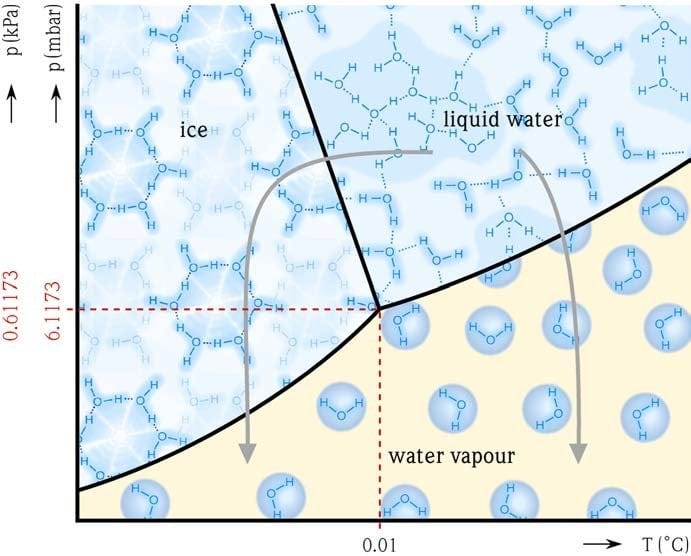
Let’s consider a case that is more likely to be resolved soon and that, in my mind at least, presents us with a perfect opportunity to study emergent phenomena: water. Specifically, its phase transitions.
Water, as I’m sure you know, is a simple substance made of H2O molecules. Yet, when enough of these molecules are put together, and depending on ambient pressure and temperature, the thing can take the properties of a solid, liquid, or gas. Moreover, it transitions from one state to another at very specific temperatures (holding pressure constant).
Now, individual molecules of water are, obviously, not solid, liquid, or gases. They don’t feel hard or wet, and so on. It seems, then, like the macroscopic properties of water – including hardness (below 0 degrees Celsius), wetness (between 0 and 100 Celsius), and the various temperatures of the phase transitions – are truly emergent.
Right, but are they weakly or strongly emergent? Does the emergence take place through supervenience or by other means?
We don’t know. In principle, the behavior of water is governed entirely by quantum mechanics. Water consists of nuclei and electrons interacting via electromagnetic forces and the Schrödinger equation theoretically describes the wavefunction of the entire system. If one could solve this equation exactly for a large ensemble of water molecules, one could derive the potential energy surface and intermolecular forces, and subsequently predict density, viscosity, boiling point, freezing point, and all phase transitions. In reality, though, solving the many-body Schrödinger equation for N particles is computationally intractable for macroscopic amounts of water (N≈10^23) due to the exponential growth of complexity.
However, there is a computational framework (if you are curious, it is a combination of Ab Initio Molecular Dynamics and Quantum Monte Carlo) that attempts to do exactly this. Currently, scientists can derive the intermolecular forces from quantum mechanics, simulate the behavior of water clusters and bulk liquid, and predict trends and anomalies with high accuracy. But they cannot (yet?) predict the exact temperature of phase transitions with perfect precision purely from first principles without relying on some empirical tuning of the quantum methods used. The promise is that the field is moving rapidly toward this goal as computing power increases and quantum algorithms improve, but the reality is that we are not there at the moment.
What would it mean for physicists to admit that water is characterized by truly (i.e., strong) emergent phenomena? That new laws of nature would come into being when enough molecules of the substance are assembled, and that such laws are not explainable by (i.e., reducible to) the principles of quantum mechanics. That would be a truly extraordinary discovery in science, but few if any scientists are betting on it. Yet, that is precisely what strong emergentism is saying.
So what’s my position about reductionism? When I was younger I was attracted by the notion of strong emergence, in great part because as an organismal biologist I simply couldn’t see how things like the development of living beings, and even less the complexity of ecosystems, could ever be reduced to physics. Now I’m not so sure, and in fact the more time passes the more I lean toward reductionism and weak emergence.
Note that a weak emergentist does not deny the existence of complex systems, nor that they are best studied at the appropriate (i.e., most informative) levels of description: it may be possible to reduce ecology to quantum mechanics, but nobody has a clue about how to actually do it, so for a long time, maybe forever, we’ll be stuck leaving the study of ecology to ecologists (and maybe geophysicists and population biologists). But unless a convincing example of strong emergence is worked out in detail, I remain skeptical that the phenomenon exists in nature.
[Next time: the ideological “isms”: positivism and scientism.]
_____
Post-scriptum: The above discussion was inspired by conversations with students in religious science at the University of Turin, during a course I co-taught there with my friend Andrea Nicolotti.
OK, OK--GUILTY! Lock him up! Me, too.
Massimo, I was surprised to learn recently that the physicist and philosopher Tim Maudlin does not consider himself a materialist. He believes that mathematics constitutes a domain of reality that is not physical. Math is simply a brute fact of the universe that is mind independent — I suppose its mathematical realism he is endorsing. I guess you don’t agree but can you explain how you think about math?