
Three arguments about determinism and free will
When logic is at odds with the desire for human freedom

Okay, folks, we haven’t talked about free will for a while! (Last time was back in April.) And I know you just can’t help yourselves from wanting more. Because you have no free will, of course. So let us take a few minutes to consider three of the most famous and consequential ancient arguments about free will and determinism, arguments that are still being debated by philosophers today.
Warning: the following will involve a bit of use of formal logic, which I will try to keep to a minimum. Then again, logic is crucial to a good life. Don’t believe me? Here is what Epictetus said in response to a skeptical student:
“When someone in his audience said, Convince me that logic is necessary, he answered: Do you wish me to demonstrate this to you? — Yes. — Well, then, must I use a demonstrative argument? — And when the questioner had agreed to that, Epictetus asked him: How, then, will you know if I impose upon you? — As the man had no answer to give, Epictetus said: Do you see how you yourself admit that all this instruction is necessary, if, without it, you cannot so much as know whether it is necessary or not?” (Discourses, II.25)
QED
The Master Argument
The first of our three arguments, known as the Master Argument, was formulated by the Megarian philosopher Diodorus Cronus (4th-3rd century BCE). It aimed to prove logical determinism through three seemingly reasonable premises that create a paradox:
1. Everything past and true is necessary, that is, what has already happened cannot be changed;
2. The impossible cannot follow from the possible, meaning that logical consistency must be maintained;
3. Something is possible that neither is nor will be true, implying that there are genuine unrealized possibilities.
The idea is that these three claims cannot all be true simultaneously, so one of the premises has to go. (The formal proof for this is, unfortunately, lost, but modern logicians seem to agree that there is tension among the three claims.) Which premise would you drop? Diodorus resolved the paradox by rejecting the third one, concluding that only what actually is or will be true counts as genuinely possible. This supports a deterministic worldview where the future is as fixed as the past.
But of course we could choose one of the other two options on the table, that is, rejecting either premise 1 or premise 2. Let’s see what would happen.
If we reject premise 1 we are effectively saying that the past is not metaphysically necessary—there’s some sense in which past events could have been otherwise.
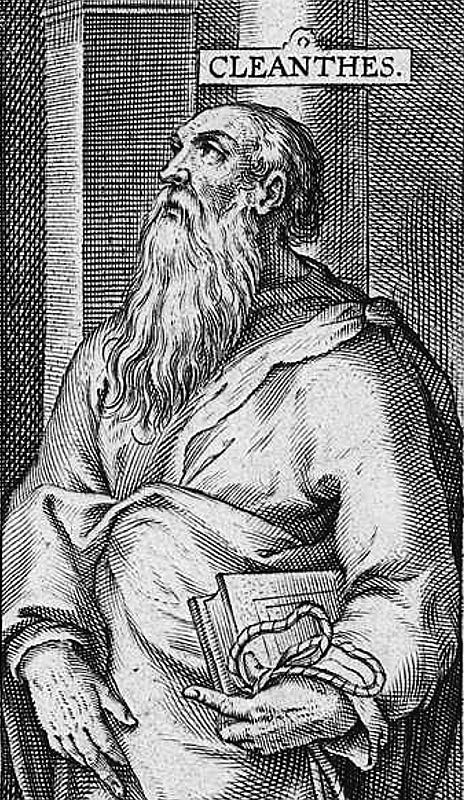
The Stoic philosopher Cleanthes of Assos, the second head of the Stoa, appears to have done away with this premise. Some sources suggest he was willing to deny the necessity of past truths in order to preserve human freedom and moral responsibility. This is philosophically bold (or foolish, as the case may be) since it challenges our intuitive sense that what’s done cannot be undone.
Rejecting the first premise, as Cleanthes did, opens space for a kind of agency that could somehow relate to or affect past events, or at least denies that past truth automatically entails necessity. It’s the most counterintuitive solution but potentially preserves the strongest notion of human freedom, which is presumably what Cleanthes wished to achieve.
What if we reject the second premise? Then logical consistency can be violated, that is, contradictory outcomes can follow from possible states. This is the least popular option among ancient philosophers, as it essentially abandons logical coherence. However, some later Academic Skeptics may have flirted with positions that questioned strict logical necessity, though it is not certain whether this was in direct response to Diodorus. Be that as it may, taking this path leads to logical chaos, at least within the framework of classical logic, and many ancient philosophers thought this to be too high a price to pay.
Broadly speaking, the Stoics found themselves caught between wanting to preserve moral responsibility in what they thought was a deterministic universe (which seemed to require rejecting premise 1) and maintaining logical rigor, since logic was one of the crucial components of the Stoic system. Different Stoics handled this tension differently, with later figures like Chrysippus of Soli (who was a logician!) developing more sophisticated so-called compatibilist positions rather than directly rejecting any premise.
The sea battle argument
Meanwhile, Aristotle, who was writing before Diodorus, had already grappled with similar issues in his famous sea battle argument, also known as the problem of future contingents, developed in chapter 9 of On Interpretation. The argument explores whether statements about future contingent events have determinate truth values, using a naval battle as the key example.
Aristotle considers the statement: “There will be a sea battle tomorrow.” According to the principle of bivalence (which says that every proposition is either true or false), this statement must be either:
* True today, or
* False today
The problem is that, if we accept bivalence, troubling consequences follow:
If “There will be a sea battle tomorrow” is true today:
* Then a sea battle must happen tomorrow;
* It cannot fail to occur;
* Human deliberation and choice become pointless.
If “There will be a sea battle tomorrow” is false today:
* Then a sea battle cannot happen tomorrow;
* Again, human agency seems eliminated.
Either way, we get determinism: the future appears fixed regardless of our choices and deliberations. Aristotle does offer a solution, which most scholars interpret as rejecting bivalence for future contingents. His position then becomes:
* Statements about the past and present have determinate truth values;
* Statements about future contingent events lack determinate truth values;
* It’s true that “either there will be a sea battle tomorrow or there won’t be” (i.e., the law of the excluded middle holds);
* But neither individual disjunct is determinately true.
This preserves genuine contingency in the future while maintaining logical principles, allowing for real human deliberation and choice, keeping genuine alternatives open, and describing a non-fatalistic universe.
The sea battle argument remains influential in contemporary debates about time, truth, and determinism, with philosophers still discussing whether Aristotle’s solution successfully avoids determinism while maintaining logical coherence.

The Lazy Argument
A third argument argument, known as the Lazy Argument, aimed at challenging the practical implications of determinism, particularly targeting Stoic philosophy. The basic structure runs as follows:
