
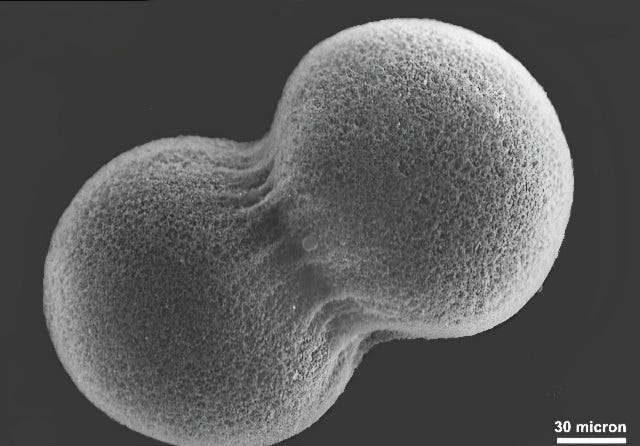
In 1888, the German zoologist Wilhelm Roux took a frog embryo at the two-cell stage and destroyed one of the two cells with a hot needle. The surviving cell developed into half an embryo, which was exactly what he expected. If an organism is a machine, he thought, then its parts are assigned their jobs in advance, and removing a component gets you a broken machine, not a smaller working one.
However, three years later, the biologist and later philosopher Hans Driesch tried something similar with sea urchins. Rather than killing one of the two cells he shook them apart, letting each go its own way. He expected two half-larvae and got two complete larvae, each perfectly formed but half the normal size.
Cut a clock in half and you do not get two small clocks, but something about the sea urchin embryo was responding to the loss of half of itself by rescaling the whole enterprise, as though it knew what it was supposed to become and was prepared to improvise about how to get there. Driesch spent the rest of his life thinking about this result, and the conclusion he eventually drew ended his career as an experimental biologist and began his career as a metaphysician.
I will come back to what Driesch concluded and to why I think he was wrong for interesting rather than embarrassing reasons. But first we need to map the territory of what he was working with – and the fact that it was missing a whole region of that territory. In other words, today we’re going to do a bit of philosophy of biology! [1]
When René Descartes, in the 17th century, described animals as machines he was not reaching for a loose analogy. He had walked the gardens at Saint-Germain-en-Laye (west of Paris), where hydraulic automata moved, played instruments, and startled visitors when they stepped on hidden plates. Here were things that behaved purposefully without having purposes, and that could be fully explained by describing their plumbing. Why should a dog be different in kind?
The French philosopher and physician Julien Offray de La Mettrie pushed the thesis to its logical conclusion in L’homme machine (1747), extending it to us. By the turn of the twentieth century the program had become a research methodology rather than a metaphysical manifesto: Roux’s so-called developmental mechanics was the discipline within which his frog experiment made sense.
The method of mechanical reduction is easy to state: decompose the system into parts, work out what each part does, and reassemble the explanation from the bottom up. And the thing is: it worked, spectacularly. Essentially everything we know about how cells actually operate came out of taking them apart, and modern molecular biology is the monument to that approach. Whatever criticisms I will articulate later, they are not aimed at a failed research program, their target is a wildly successful program that may nonetheless have been telling us a misleading story about what kind of thing it was studying.
Driesch’s conclusion – the one that cost him his career as a biologist – was that development required a non-material organizing principle, for which he borrowed Aristotle’s classical term: entelechy, the actualization of a potential. Around the same period, Henri Bergson (1859-1941) was writing about the élan vital (vital impulse), and behind both stood a long medical tradition that held living matter to be governed by forces of its own, which would make biology an independent scientific discipline from physics and biological principles and phenomena not reducible to those of physics.
It is worth saying clearly that these people were not mystics. They were tracking real phenomena that the mechanical picture of living beings genuinely could not accommodate at the time: the complex regulation of biological processes, the regeneration of biological structures, the reliability of development under a variety of environmental conditions, and the way organisms behave as though aiming at outcomes (so-called teleology). Driesch’s sea urchins were a real result, and no mechanicist in 1891 had anything remotely adequate to say about them.
The problem with entelechy was never that it was spooky, so to speak. It was that it did not work. “Development is regulative because entelechy directs it” has the same logical structure as Molière’s physician explaining that opium induces sleep because of its “dormitive virtue.” The name of the mystery has been changed, but nothing has been added. Vitalism wasn’t even a theory. It was, rather, a placeholder wearing a theory’s clothes.
Although it is often said that vitalism was experimentally killed when the German chemist Friedrich Wöhler synthesized urea in 1828, proving that organic compounds required no vital force, this is both somewhat true and yet a bit too simple a story. Wöhler himself did not read his result that way, and vitalism carried on being a live scientific position for the better part of a century afterwards. What actually killed it was the slow, unglamorous accumulation of successes in biochemistry, which did begin with the artificial synthesis of urea and kept, bit by bit, doing the explanatory work that entelechy and the élan vital had only promised and never delivered.
I would, therefore, happily leave vitalism in the nineteenth century, except that it has been coming back, and in a form its founders would not recognize as an improvement. The current version does not talk about vital forces but about cognition, consciousness, and sentience, and it distributes them generously. We are told that plants make decisions, remember, learn, and possess something worth calling intelligence – Stefano Mancuso and Monica Gagliano being the most visible advocates – and, further out, that bacteria have minds, or that experience goes all the way down into matter itself.
Mind you, some of this rests on real and interesting findings. Plants do sense, signal, integrate information about their environment, and modify their behavior accordingly, and the mechanisms are genuinely worth studying. Indeed, I spent over two decades as an experimental biologist researching a major way in which plants respond adaptively to changes in their environment, known as phenotypic plasticity. What is not established is that any of this requires the vocabulary of mind. The move from “responds adaptively to environmental cues” to “decides,” “remembers,” and “knows” is not a discovery, it’s a redescription, and it smuggles in exactly the thing it is supposed to demonstrate.
This is nothing but the old vitalist error in new clothing. Entelechy named the mystery of development and called it an explanation. Similarly, “plant cognition” names the mystery of adaptive behavior without a nervous system and calls it an explanation. In both cases something real and unexplained is being labeled rather than accounted for, and in both cases the label is borrowed from a domain where we think we already understand what is going on.
So no, the machine metaphor is not to be escaped by declaring that everything is a little bit conscious. But it does need escaping, and there has always been a better way out.
Here is the move that I think unlocks the whole debate. It seems to me that two quite different questions have been consistently run together:
(i) What are organisms made of? Only matter and energy, obeying only the laws of physics and chemistry? Or is there something extra?
(ii) Can organisms be explained by taking them apart? Is a complete account of the components and their interactions a complete account of the organism?
