
Two masks, one stage
Stoic role ethics from Panaetius to Epictetus
Imagine you have just been passed over for a promotion you deserved. One of your colleagues – less experienced, less diligent, better connected – got the job instead. You are a middle manager at a company you have worked for twelve years. You are also a parent, a spouse, a friend to several people who depend on your equanimity. You are, let us say, someone with a naturally competitive temperament, who has always cared, perhaps too much, about recognition. What should you do? More precisely: what does Stoicism say you should do?
The answer, it turns out, depends on which Stoic you ask. And the difference between two of the most sophisticated answers ever given – one from Panaetius of Rhodes, transmitted to us by Cicero in On Duties, the other from Epictetus in his Discourses and Enchiridion, as reconstructed by Brian Johnson in The Role Ethics of Epictetus – reveals a genuine fault line running through the entire tradition.
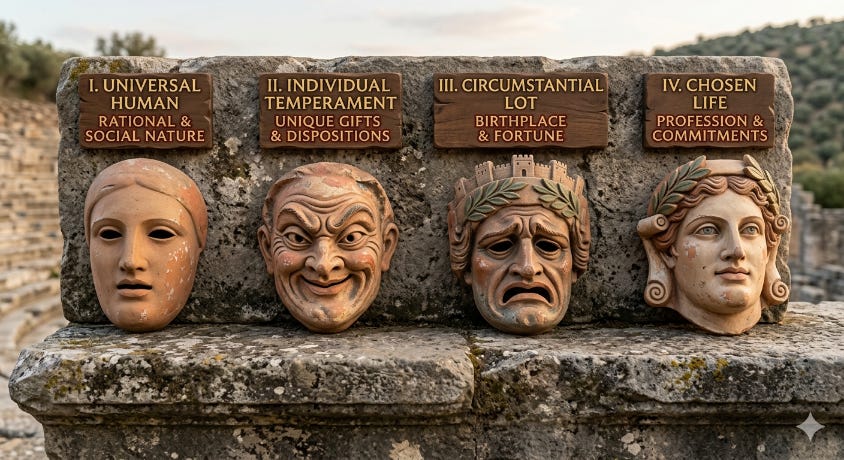
Panaetius, the second-century BCE Stoic who became a close friend of Scipio Aemilianus and did more than anyone to bring Greek philosophy into the Roman mainstream, developed what we might call a pluralistic account of moral identity. Cicero, in De Officiis, describes it as the doctrine of four personae, four masks or roles that every person wears simultaneously.
The first mask is universal: we are all rational and social animals, and this grounds the obligations we share with every other human being regardless of circumstance. The second mask is individual: each of us has a particular temperament, a constellation of natural talents and tendencies that distinguish us from everyone else. The third mask is circumstantial: the family we were born into, the country and historical moment we inhabit, the social position fortune has assigned us. The fourth mask is chosen: the profession we pursue, the philosophical school we join, the commitments we voluntarily undertake.
Panaetius’s central ethical concept is decorum, that is, appropriateness, fitting conduct. The virtuous person is not someone who applies a single universal algorithm to every situation, but someone who has the practical wisdom to act at the intersection of all four roles. And crucially, the second mask (individual temperament) carries real moral weight. Panaetius is explicit, and Cicero enthusiastically agrees: you should not force yourself to be what you are not. The person of reserved, scholarly temperament should not pretend to be a gregarious political operator; the naturally witty person should cultivate that wit rather than suppress it in the name of some generic ideal of Stoic gravitas. Nature has given you a particular character. Work with it, not against it.
Returning to our passed-over manager: Panaetius would want to know a great deal about you before prescribing anything. What is your natural temperament? Does the competitive streak run so deep that suppressing it will produce a simmering resentment that poisons your relationships? What are your social roles? Do your children need a parent who models resilience, or one who models the willingness to fight for fairness? What did you voluntarily sign up for when you joined this company? What are the implicit obligations of that chosen role? The Panaetian answer is thick, contextual, and irreducibly particular. There is no formula: there is only the trained judgment of someone who knows themselves well across all four dimensions.
Epictetus would find all of this interesting, and then he would set most of it aside. For Epictetus, the former slave from Hierapolis who became the most psychologically penetrating of all the Stoic teachers, the multiplicity of roles is acknowledged but not the main event. The theatrical metaphor he uses is precise and deliberate: we are actors in a play whose script was written by someone else. The Author, be it God, Zeus, Nature, or the rational structure of the cosmos, assigns us our parts. One person is cast as the rich man, another as the pauper. One plays the role of the healthy athlete, another the chronically ill. Some of us are given the role of the politically powerful, others spend decades under circumstances not of their choosing. The actor’s job, and it is the only job that matters, is to play the assigned role excellently, with full rational attention, integrity, and presence.
