
The problem with presentism
How should we evaluate the moral standing of people and cultures from the past?
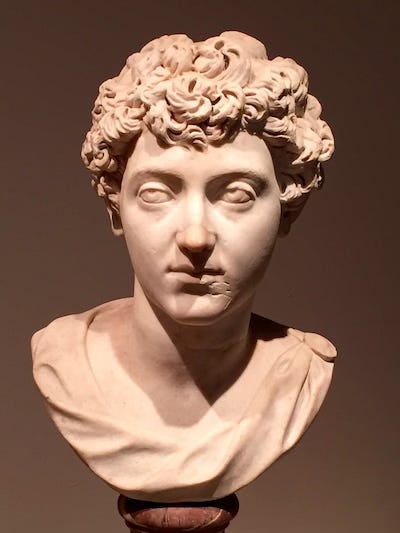
Consider Marcus Aurelius: was he a wise ruler whose actions were informed by Stoic philosophy, or a brutal colonialist enforcing imperial rule? I have had this discussion recently on Substack’s Notes as a follow up to an article I wrote in which, among other things, I suggested that modern Stoics should stop regarding James Stockdale a role model.
Stockdale was an American pilot who was shot down during the Vietnam War. He was apprehended and spent several years in a Vietnamese prison where he endured torture and abuse. Stockdale credited his survival to having read the Stoic philosopher Epictetus and having internalized his famous fundamental rule: some things are up to us, others are not, and the key to life is to focus on the first ones and develop an attitude of equanimity toward the latter.
In my article I argued that Stockdale’s use of Stoicism is an example of (successful!) life hacking, but not of actually practicing the philosophy. You see, Stockdale had been present at the infamous incident of the Gulf of Tonkin, which the United States used as a pretext to start the war. The US Government claimed that the Vietnamese had attacked American ships unprovoked. But Stockdale was actually there and knew that this was bullshit. Nevertheless, he kept quiet and willingly participated to an unjust war that he knew had began under false pretenses. Not, I argue, what I’d expect from a Stoic role model.

My criticism of Stockdale provoked a range of responses, and more than one reader pointed out that arguably even Marcus Aurelius, one of the three big Roman Stoics, did not truly act as a Stoic. After all, he was at the head of an oppressive empire, and besides he persecuted the Christians.
That’s an interesting argument, and it deserves to be taken seriously. It consists really of two components: on the one hand, there is a factual element to it. How oppressive was the Roman Empire? Did Marcus actually persecute Christians? On the other hand, there is a philosophical element to it: is it a good idea to project our modern moral standards onto cultures of the past, a practice often referred to as “presentism”?
On the factual side, there is no question that the Romans were an imperial power. Then again, so was every other power on the globe, from the Parthians to the Chinese. So the choice, so to speak, wasn’t whether to live under imperial control but rather under which particular empire. By the standards of the time, the Romans were among the mildest of rulers, largely interested in maintaining the peace and collecting taxes. And they did significantly improve the life of their subjects across their domain. (For a funny rendition of the latter point see here.) Also, did Marcus persecute the Christians? Apparently not, though other emperors certainly did.
But what concerns me the most here is the philosophical issue underlying the practice of presentism. Did my critics engaged in presentism when they pointed out Marcus’s alleged sins? Did I do it when criticizing Stockdale? Let’s take a look.
To begin with, presentism is defined as the introduction of present-day ideas and perspectives into depictions or interpretations of the past and it is often (but, crucially, not universally!) considered by historians a form of cultural bias. We tend to think of our own cultural mores as unbiased, as if history had somehow reached the end and apex with us, so that we are justified in using our own standards as the golden ones. But of course that’s nonsense on stilts and a result of hubris, not rational thinking. We are one more culture among many that have marked, and will mark, the history of humanity. In a number of respects we have arguably improved on the past, and in a number of others we have not. And who knows what future generations will think of our stage of moral development.
Historian David Hackett Fischer thinks of presentism as a fallacy, as he explains in his Historians’ Fallacies: Toward a Logic of Historical Thought (Harper Torchbooks, 1970). Specifically, he says that presentism is analogous to the practice of nunc pro tunc (“now for then”) in law, where a new statute is applied retroactively to correct an old one. This is arguably an unfair practice, as people who were operating in good faith under the old statute now risk being prosecuted for something that, at the time, was perfectly legal.
A classic example of presentism is so-called Whig history, popular in the 18th and 19th century, when some politically biased historians wrote in such a way as to use the past to validate their own preferred political opinions.
That said, there are principled defenders of presentism. Some of them point out that to write, for instance, about colonial slavery without criticizing it is to tacitly endorse the point of view of the oppressors. Historian Steven F. Lawson writes: “In addition to the various forms of resistance embraced by enslaved peoples, opponents of slavery in the 18th and 19th centuries, including Quakers and abolitionists, objected on moral grounds to the enslavement of Africans.” (“History’s ‘problem’ isn’t really ‘presentism’ at all,” Tampa Bay Times, 8 September 2022)
The point Lawson is making is a good one: there were people who fully realized the immorality of colonial slavery at the time, and they went so far as acting on that belief. However, that is precisely the approach I am advocating: rather than project our own standards onto the past, let’s look at where people in a certain time period and culture stood by comparison with their contemporaries.
If we follow this modified approach, I argue that Stockdale does not fare too well, as there were plenty of people in the ‘60s and ‘70s who thought the Vietnam War was unjust. Marcus Aurelius, by contrast, was highly esteemed by even the most exacting of his peers as well as by multiple successive generations.
A different group of defenders of presentism claims that not to engage in criticism of past practices is a form of moral relativism. Interestingly, many of these people are religious historians, who assume the existence of universal, unchangeable moral laws established by God.
There are two problems with this take. First off, to reject presentism is not at all the same thing as professing moral relativism. I can consistently hold that there is such thing as moral progress, and yet also acknowledge that ancient Romans had not yet gotten to the level of moral knowledge we enjoy today.
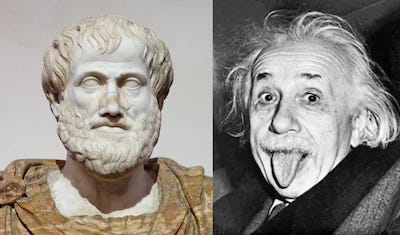
Consider an analogy with science: I am not a knowledge relativist if I say that Aristotle ought to be understood within the context of his time, and not by comparing his achievements with those of Einstein or Darwin. So the relativism accusation is off base.
As for the existence of universal moral laws established by God, well, I am an atheist, so that path is precluded to me. Indeed, even if you are a theist, you should read Plato’s Euthyphro dialogue, where Socrates very clearly establishes that morality cannot have anything to do with dictates from the gods, unless one is willing to say that divine morality is of the might-makes-right type. (See my two part essay in Philosopher’s Magazine.)
In the latest iteration of the debate on presentism, some conservative critics have accused those who practice it of “wokism.” I am certainly not about to enter here into a discussion of woke culture, whatever that may be. But as much as I automatically distrust right-wing extremism, even a broken clock is right twice a day, and I have seen flagrant and hard to justify examples of woke-inspired presentism popping up in public discourse.
Let us finally go back to Marcus Aurelius, and compare him to the other two big Roman Stoics, Seneca and Epictetus, in an effort to further clarify my position.
We can adopt the standard implicit in Lawson’s comment above: while presentism as we defined it at the onset is indeed fallacious, it is permissible to examine the moral standing of past figures or practices by contextualizing them within the culture and time from which they emerged.
I have already argued that according to Lawson’s approach Marcus fares very well. He was one of the wisest and mildest emperors of the entire history of Rome, and even by comparison with other rulers in the Mediterranean area. Moreover, he did very consciously try to practice Stoicism, not as a life hack a la Stockdale, but as a philosophy of life.
Contrast this with Seneca, whose tenure as Nero’s advisor tainted his reputation, not just with modern audiences, but with his contemporaries and immediate successors. I have argued that even his case is not at all clearcut, and that Seneca possibly did his best, showing a significant amount of courage, for instance when he wrote On Clemency, in which he several times not so subtly threatens the new emperor with an ignominious end if he doesn’t govern virtuously. And let’s not forget that, whatever his failings, Seneca paid with his life his attempt to distance himself from Nero and the fact that he likely knew of the (failed) Pisonian conspiracy against the emperor and did not divulge such knowledge to the authorities.
What about Epictetus? Well heck, he was essentially a sage by both the standards of his own time and contemporary ones! What we know of him is that he very much lived what he preached, sticking to a simple life of teaching. Near the end of it, he even adopted the child of a friend, who would have otherwise died, and raised him as his own.
To recap, then: I think presentism is a mistake mostly because it precludes us from learning anything valuable from the past and because it is the result of chauvinistic hubris rooted in a simplistic view of the present. At the same time, we cannot and should not abstain from a moral evaluation of past figures and cultures, because we are not just doing history, we are doing ethical philosophy, and we are expressly using the past (good and bad!) as a guide to the present and the future.
Superb clarification of the term! 👍😊
Gentle chiding only. Flourish on your journey.