
The ancient contrast between otium and negotium
How to reclaim time for yourself without fleeing the world
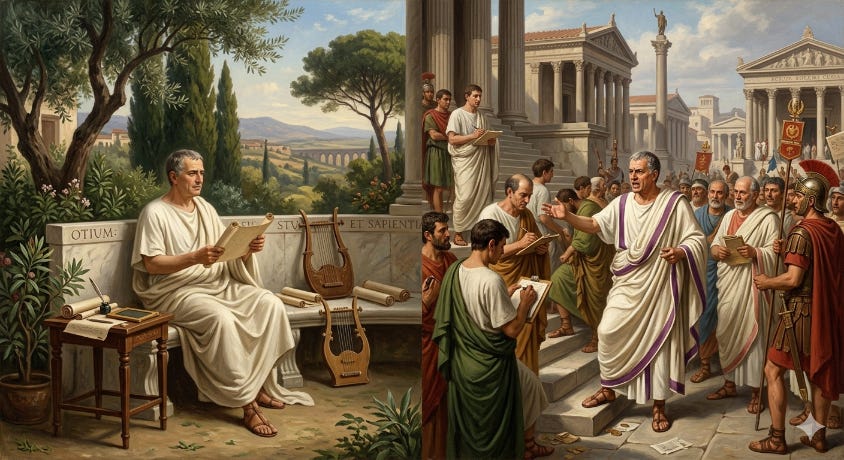
There is a Latin word that has no satisfying translation in English, and precisely for that reason it is worth pausing on it. The word is otium.
It does not mean “idleness” in the sense we usually intend: laziness, inactivity, time wasted on the couch. In Latin, otium denotes something precise and precious: time free from public and professional obligations, dedicated to what nourishes the mind and spirit. Reading, reflection, philosophical conversation, writing, study. For Roman intellectuals, otium was not an occasional luxury but a structural necessity of the well-lived life.
Its opposite was negotium, literally, the negation of otium: business, public duties, work, social obligations. The nec-otium, that which is not rest.
Seneca returns to this distinction throughout his writings, and particularly in the Letters to Lucilius, one of the most beautiful works in Latin literature, written in the final years of his life after he had almost entirely withdrawn from Nero’s court. His position there is more nuanced and more interesting than it might initially appear.
The temptation, when reading Seneca on otium, is to interpret it as an invitation to escape: abandon the world, retreat to the country villa, close the door on obligations, and devote yourself to philosophy in peace. And indeed, in certain passages, Seneca seems to say exactly this.
But there is a specific text – the De otio (“On Leisure”) – in which his position becomes more complex. Seneca is perhaps responding here to an objection raised by more orthodox Stoics: how can you justify withdrawal from public life, if Stoicism teaches that the sage must participate actively in the community?
Seneca’s answer is elegant. He argues that there exist two republics: a small one, that of the city or state in which one is born, and a great one, that of all humanity. Even someone who withdraws from the first can continue to serve the second: through writing, thinking, and the formation of those who come after. The philosopher’s otium is not an abandonment of the world: it is a different way of being in the world and contributing to it (De otio, 4).
This distinction has an interesting modern echo. Today we might call it the contrast between reactive, visible work and deep, generative work; or between responding to immediate stimuli and producing something that lasts. Seneca was saying, in essence, that not all contribution to the world passes through direct and visible participation: some of the most important things are done in silence, alone, with unstructured time available.
We live in an era that has structurally abolished otium. Not in any legal sense – no one compels us to be connected twenty-four hours a day, yet – but in a cultural and technological sense. The devices we carry everywhere at all times have made the distinction between otium and negotium nearly impossible to maintain.
The problem, as usual, is not technology itself: it is that we have accepted, often without noticing, a conception of time in which every unproductive moment is regarded as wasted, where silence is uncomfortable and must be filled, and in which boredom – which psychologists now recognize as a valuable mental state, necessary for creativity and for the processing of experience – is treated as a problem to be immediately solved with some kind of stimulus.
Seneca would have recognized this as a particularly sophisticated form of wasting time. We are extremely busy, always occupied, our calendars full, but how much of this activity is genuine negotium, that is, necessary and meaningful work, and how much is a form of distraction dressed up as productivity, “busyness,” if you like?
The Stoic philosopher was not naive. He knew perfectly well that having free time is not enough to use it well. Low-quality otium, that is, time spent drifting without direction, constantly switching activities, seeking distractions, produces nothing of value and nourishes no one.
Seneca diagnoses this restlessness with particular sharpness in a letter on travel as a cure for discontent. There he offers a Socratic rebuke to those who have crossed vast distances and changed scene after scene without managing to shake off their gloom: why be surprised that globe-trotting hasn’t helped, when you take yourself with you wherever you go? What you need, Seneca insists, is a change of soul, not a change of climate (Letters, 28.1–2). The problem is not a lack of free time, nor the wrong location: it is the lack of an interior center from which any time, anywhere, might be inhabited with profit. Restlessness merely relocates the burden, it never sets it down.
High-quality otium, for Seneca, has some precise characteristics. It is voluntary and intentional: one chooses to be in that time, rather than finding oneself there by accident. It is oriented: there is something one wants to do, think, read, or write, even if that something produces no measurable result. And it is long enough to allow depth: fragments of time between one obligation and the next do not suffice, as the mind needs to stretch, to descend into depth, and this requires continuity.
The practical question is inevitable: how does one actually do this, in a normal life full of real commitments and genuine responsibilities?
Neither Seneca nor I have a universal recipe to offer. But a principle emerges clearly from his texts: otium must be actively defended, because negotium invades it spontaneously and leaves no space on its own.
This means, in the first place, learning to say no – to commitments accepted out of habit, courtesy, or fear of disappointing, without their having any real value in one’s life. It also means to choose carefully one’s friends:
“Withdraw into yourself as much as you can; associate with those who are likely to improve you. Welcome those whom you are capable of improving. The process is a mutual one: men learn as they teach” (Letters, 7.8)
The principle extends naturally to the management of one’s time: not every request for your attention deserves to be granted.
It also means, in the second place, stopping measuring the value of time solely in terms of visible production. Time spent reading a difficult book, taking a walk without a phone, talking with someone you love without hurrying, this time “produces” nothing measurable, but it provides something real: depth, clarity, capacity for thought, and quality of presence.
And it means, in the third place, recognizing that otium is not a reward earned after finishing all the negotium. One never finishes everything, and if one waits to have exhausted all obligations before allowing oneself time, that time never arrives. Otium must be actively carved out of negotium, as an act of choice and priority, not as a residue of whatever happens to be left over.
I want to linger on a few examples of people who seem, in different ways and different eras, to have understood this balance intuitively. After all, as the Stoics kept reminding us, it is very useful to set oneself role models from whom to learn.
Charles Darwin had a daily structure at Down House that was almost obsessively regular. He worked in concentrated bursts of no more than ninety minutes at a stretch, then stopped for a walk on the “thinking path” he had built in his garden, for correspondence, or for rest. And he never worked in the afternoons. This rhythm was partly imposed by his chronic ill health, but Darwin defended it as a matter of principle, not merely necessity. The otium was not the absence of work: it was the condition that made the work possible. The Origin of Species, his books on geology, the volumes he wrote on barnacles and earthworms and orchids – all of it emerged from a life in which deep rest was structural, not incidental.
Montaigne offers a different but equally instructive case. At the age of thirty-eight, he retired to his tower in the Périgord, had Latin inscriptions carved into the beams of his library ceiling, and began to write what would become the Essays. His stated purpose was explicit: to study himself, to record his thoughts as they came, without the pressure of public purpose or professional obligation. The result was one of the most original and influential bodies of writing in the Western tradition, produced precisely because Montaigne had created a space of otium so complete that thinking became the only available activity. He was not fleeing the world, however, he was serving the second, larger republic that Seneca described, the republic of all readers across all time.
Closer to our own era, the mathematician and philosopher Bertrand Russell wrote an essay in 1932 called “In Praise of Idleness” that makes, from a secular and empirical direction, almost exactly Seneca’s argument. Russell contended (already almost a century ago!) that the cult of productivity had impoverished modern life, that four hours of concentrated work per day was sufficient for any serious intellectual contribution, and that the remaining hours ought to be genuinely free, not filled with improving activities or structured leisure, but left open for the mind to wander, make unexpected connections, and recover the capacity for genuine attention. Russell was no Stoic, and the essay has its provocations and exaggerations. But the underlying intuition – that negotium without otium is self-defeating, that the two are not enemies but partners – is one Seneca would have recognized immediately.
What these examples share is something that goes beyond time management, beyond the practical question of how to schedule a day. They point toward a conception of the self as something that requires cultivation – not just exercise and nutrition, not just professional development, but genuine interior space in which thought can deepen, experience can be processed, and values can be examined. Seneca makes this point with particular force in the very first letter to Lucilius:
“Nothing, Lucilius, is ours, except time.” (1.3)
The fact is that time is the only resource that genuinely belongs to us, and yet we give it away with a carelessness we would never apply to money, property, or reputation. This is not an argument for selfishness or withdrawal from obligation, but an argument for paying attention to what one is actually doing with the irreplaceable material of one’s life.
Another essay on the same topic, the De brevitate vitae, is written by Seneca as a letter to a man overwhelmed by the demands of public life – his father in law, Pompeius Paulinus. In it we read:
“Can anything be sillier than the point of view of certain people – I mean those who boast of their foresight? They keep themselves very busily engaged in order that they may be able to live better; they spend life in making ready to live! They form their purposes with a view to the distant future; yet postponement is the greatest waste of life; it deprives them of each day as it comes, it snatches from them the present by promising something hereafter. The greatest hindrance to living is expectancy, which depends upon the morrow and wastes today. You dispose of that which lies in the hands of Fortune, you let go that which lies in your own.” (9)
This could easily have been written today, as the demands have changed their form, but their tendency to devour everything has not. Otium, again, is not what remains after negotium has taken its share. It is what must be protected first, so that the negotium that follows has a human being behind it – someone present, capable of depth, capable of genuine attention – rather than a very efficient machine running on empty.
The Stoics liked to remind us that philosophy is not an ornament of life but its architecture. Otium, in this sense, is not a philosophical luxury reserved for retired senators or tower-dwelling essayists. It is the condition under which a human life remains recognizably human – capable of reflection, capable of depth, capable of asking whether what we are doing is actually what we want to be doing with the time we have.
The negotium will always be there. It will expand to fill whatever space you give it. The question Seneca keeps pressing, in writing after writing, is whether you have decided – actually decided, as an act of will – what you will protect from it. Not what you will do when it’s finished, but what you will refuse to let it touch.
A peasant never had to choose otium. Necessity took the time, but necessity is not a negotiating party.
Seneca had to choose. De otio is a defence, and you write a defence only when something with a claim on your time has made one first. The state could give reasons. He had to give reasons back. That was his class's problem centuries before there were factories. Industrial time did not invent the claimant. It gave everybody one.
Play in other mammals runs on the opposite logic. It appears only when the animal is healthy, has energy to spare, and is buffered from stress and danger. Burghardt builds that into the definition rather than treating it as a lucky background condition. Play happens in a relaxed field, and it is the first thing to go when pressure arrives.
Saying no, refusing to measure by visible output, carving the space out first: all of it loads the will. If otium is released by conditions in every other animal, some of ours probably works that way too. We need discipline for something rats do for free. That may be a fact about the arrangement rather than about our character.
It's interesting how this is framed as a choice: "how can you justify withdrawal from public life, if Stoicism teaches that the sage must participate actively in the community?" What happens when public life includes a calendar, a cycle of ritual, a discipline of practice, that INCLUDES an obligation to create unstructured time for reflection, learning, study in the form of intellectual, emotional and (dare I say it because it is so woo-woo-ey and ill defined) "spiritual" development? Two things: First, it may be easier to find the time to do this work if you have co-travelers so engaged. And second, some of those colleagues might turn out to be either your teachers or students, mentors or mentees. As guides, your colleagues will be supporting your own individual work and supporting them as peers they actually represent service to your community. Some religious institutions, alumni groups, book clubs, adult education programs, volunteering organizations and so on serve precisely this function. I'm pretty sure this is not a novel idea. Just an observation.