
Suggested Readings
A few recommendations by Figs in Winter for your reading pleasure
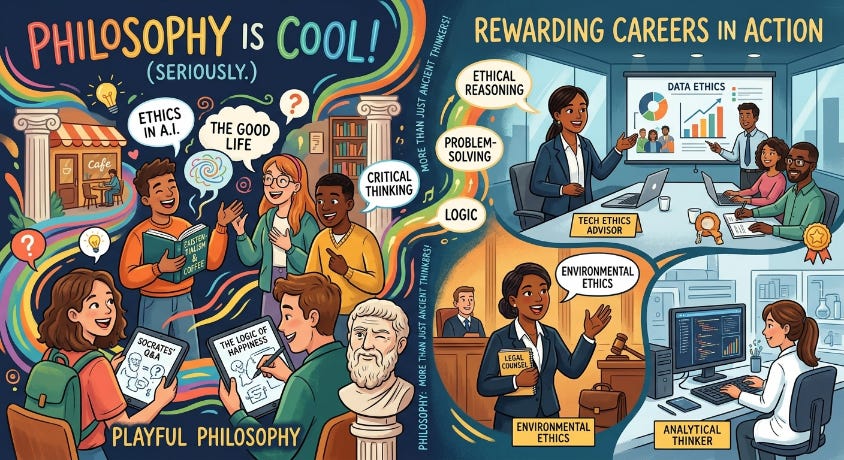
The revenge of the philosophy majors. Growing up in Georgia, Robert Long was given to pondering big questions and the meaning of life — before he was 10, he doubted his own free will. But it wasn’t until college, where he majored in social studies, that he learned he could think about consciousness full time. He read a book by Douglas Hofstadter called “I Am a Strange Loop,” which explored mysteries such as What is a self? “I didn’t even realize that those were questions you could ask,” he says, “and then that there were philosophical disciplines about them.”
When Mr. Long entered graduate school at New York University, to study the philosophy of mind, it was with a conventional ambition. “I was very much on the path of publishing in journals, go on the job market, get a job at a university,” he said. When a fellow philosophy Ph.D. candidate told him that she was going to an obscure nonprofit called OpenAI to work on artificial intelligence policy, “I was like, that’s kind of random.”
But Mr. Long, too, found his philosophical interests trending toward A.I. His dissertation was titled “Essays on the Philosophy of Machine Learning.” And he moved to San Francisco to pursue postdoctoral research in early 2023, just when ChatGPT was blowing up. As the new large language models began displaying uncannily humanlike behaviors, he awoke to the dawning significance of potentially conscious A.I. — and to the possibility that something professionally interesting might happen if he stuck around. … (New York Times)
Anti-science is a weapon of mass destruction. I recently happened to come across an old (8 years) YouTube video of Australian senator Pauline Hanson questioning Rear Admiral Greg Sammut on their plan to acquire Shortfin Barracuda Block 1A submarines from France (a plan since replaced). Her line of questioning presumed that the decision had been made haphazardly with little regard for — well, anything. It also revealed that she had not the slightest amount of general common knowledge about mechanical things. Poor Adm. Sammut showed extraordinary patience as he constantly had to explain the most basic facts about submarines to her. It was like teaching calculus to a goldfish. … (Brian’s Bullshit-Free Zone)
How to become wise. ‘We are unknown, we knowers, ourselves to ourselves,’ wrote Friedrich Nietzsche at the beginning of On the Genealogy of Morals (1887). This seeking after ourselves, however, is not something that is lacking in Buddhist and Confucian traditions – especially not in the case of Korean philosophy. Self-cultivation, central to the tradition, underscores that the onus is on the individual to develop oneself, without recourse to the divine or the supernatural. Korean philosophy is practical, while remaining agnostic to a large degree: recognising the spirit realm but highlighting that we ourselves take charge of our lives by taking charge of our minds. It is also a tradition of philosophy largely unknown to the West. But I hope that is changing. … (Aeon)
The secret of human intelligence may lie in the power of a single brain cell. What makes the human brain capable of language, imagination, mathematics and invention? For many years, the prevailing view was that the secret of human intelligence lay mainly in scale: the sheer number of neurons in the human brain—close to 100 billion—and the vast network of connections among them. But a new study published in the Proceedings of the National Academy of Sciences suggests that part of the answer may lie at a much smaller scale: in the extraordinary computational power of individual brain cells. … (Medical Xpress)
Scientists are incredibly easy to fool. Scientists are the people with the deepest knowledge in their fields of expertise. That’s all. They’re not necessarily unusually knowledgeable or skilled in other things — no more so than anyone else. That’s not a jab or an insult. I’d say the same thing about you: If you’re a mortgage broker, you probably have very deep knowledge about the current mortgage landscape; but I shouldn’t expect you to also know everything about scuba diving.
If my headline seems a little clickbaity, well, yeah; if I had written it dispassionately, it would have said NON-EXPERTS IN FOOLING PEOPLE ARE BAD AT KNOWING WHEN THEY’RE BEING FOOLED. And you would have rightly said “No shit, Sherlock.” But since I said scientists, you may have taken it as a bit of an affront to scientists. It’s not at all.
Why, then, do so many people hire scientists when they’re actually looking for skill in the arts of deception? … (Brian Dunning's Bullshit-free Zone)