
Suggested Readings
A few recommendations by Figs in Winter for your reading pleasure
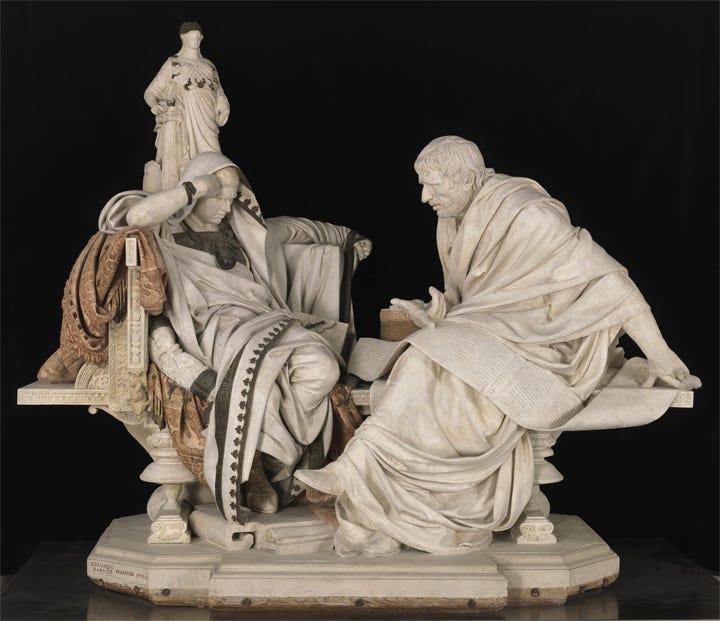
Seneca and Nero: the ultimate test. If you’re a committed Stoic and a phone call comes asking you to serve at the highest level of an autocratic government, what would you do? What should you do? Say you agree to serve and become chief minister to the ruler, but discover he’s immoral, corrupt, vain, and only loosely tethered to reality. What should you do? Should you remain in service in hopes of keeping the state from imploding? Or should you preserve your own soul by getting as far from the palace as possible? … (Stoicism Today)
Footnotes to Plato? What Whitehead really thought. Perhaps the most famous quotation by the great early 20th century philosopher Alfred North Whitehead is this one:
The safest general characterization of the European philosophical tradition is that it consists of a series of footnotes to Plato.
As is often the case, on its own, this sentence ends up being rather misleading. It easily lends the impression that Whitehead accords Plato an absolute priority within the long history of philosophy. You’ll see people occasionally quoting it as if it conveys a judgement similar to “there is nothing new under the sun.” … (That Philosophy Guy)
Of the many types of Roman gladiator, some were definitely women. “If I win, Toxaris, we shall go away together, with all that we need; but if I fall, bury me and go back to Scythia.” These were the last words of Sisinnes in the arena at Amastris. “I have lived long enough,” a poor young volunteer in another arena said to the friend he had replaced on the sand. Just two words in Latin (satis vixi), concise and powerful, but there was time for more: an explanation of why he was there, a last kiss through his visor, and a second valedictory. “By this my last glimpse of the light, by the celebrated sincerity of our love, do not let my father have to beg; sustain him, help him, give him your affection; if I merit it, be my substitute in caring for him.” … (Literary Hub)
The Pentagon released its UFO videos – so I went to the US to chase aliens. This is what I found. I never gave much thought to aliens beyond Star Wars. I put extraterrestrials and their flying saucers in a box marked “nonsense” long ago, along with political manifestos, loyalty cards, Black Friday, fairies, pixies, elves, ghosts and ghouls. Then, in 2017, the New York Times published an article with the headline “Glowing Auras and ‘Black Money’: The Pentagon’s Mysterious UFO Program”. Apparently, the US government had been chasing UFOs for years. These weren’t the ramblings of the kind of straw-chewing rancher you would see in a sci-fi film; the story was told by a military intelligence officer called Luis Elizondo. He claimed he ran a secret Pentagon programme called the Advanced Aerospace Threat Identification Program (AATIP), which had found evidence that UFOs were flying around military bases, behaving in ways that defied the laws of physics. … (The Guardian)
How reading books regulates your nervous system. There’s a feeling I love almost more than anything: the feeling of sinking into a good book while the world around me fades away. My breathing slows, my shoulders drop, and the mental chatter in the back of my mind goes quiet. What’s happening in those moments goes far deeper than entertainment or education, and we seem to sense this instinctively. Reading is relaxing, and many people do it as a counterbalance to our overstimulated age. But what exactly is happening when we read? What’s going on beneath the surface that makes reading a book feel so restorative? The answer lies in how reading changes our neurochemistry in real time. Reading isn’t just about decoding words on a page. It’s a complex neurochemical process that affects everything from our heart rate to our hormone levels. … (Big Think)
The James Romm keynote was great. Very relevant to my own particular circumstances at the moment as a political and social activist.
My to-read "stack" of articles and books teeters ever more precipitously. Thanks.