
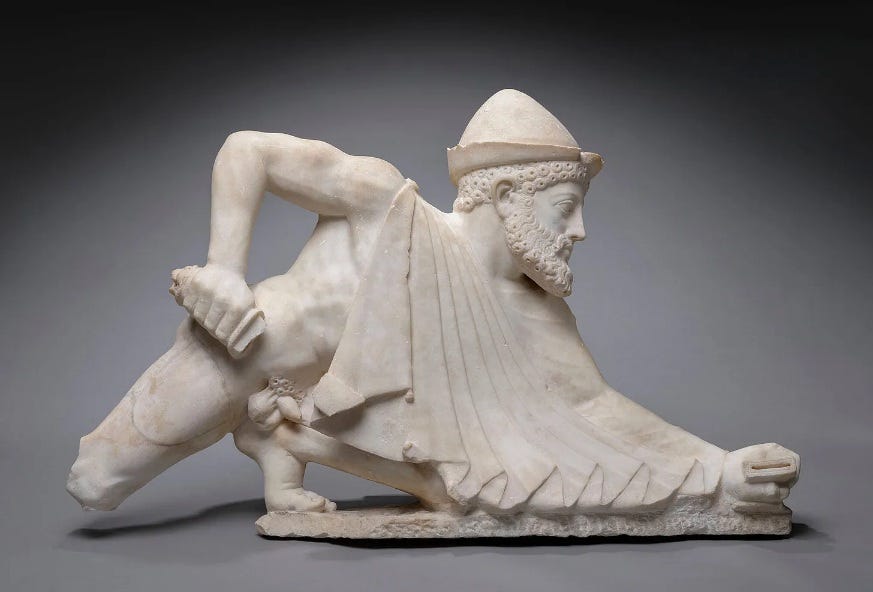
An Odysseus wrecked with guilt. I did it! I went to see Christopher Nolan’s Odyssey on a quasi-Imax screen, well, not quite the genuine Imax experience, but big enough and loud enough that I felt my seat shake as Odysseus sailed the rough waters out of Troy. This Odyssey is a homecoming. But it’s not the original one, Homer tells. Homer’s tale, from the Iliad to the Odyssey, is about warrior glory, honor, revenge, and yes, a homecoming to “call off this battle now.” This last battle is on the homefront against suitors encamped in his home and vying to win Penelope’s hand and with it, the crown of the Ithaca kingdom, wrenching it from Odyss,eus presumed dead. But he lives and fights the last battle, this one in his own home. In this action movie, that battle goes on and on and on, with make-shift weapons slithering down from a hole in the ceiling and surprising even the fighters. And yet, the movie is about regret for violence, anguish about war, guilt in losing battle buddies, and the realization that even sharp cunning can’t outsmart an angry god. Zeus might want hospitality and peace. But it’s the experience of war we see. … (Nancy Sherman's Substack)
The freedom to fly away. My friend’s husband had a parakeet named Delilah.1 Delilah had free rein of the lounge room. (The floors were parquet and her droppings were easy to clean up.) All day, every day, Delilah would sit on the retiree’s shoulder while he watched TV or pottered around the apartment.
One day, the husband went downstairs to open the door for his wife. Delilah flew away. He searched for days and days. She was nowhere to be found. He was heartbroken. It never occurred to him that she would leave him. He loved her. She loved him, didn’t she? Why would she escape the first chance she got?
In The Ethics of Ambiguity, Simone de Beauvoir writes, “Even if it does not definitely disappear, the object never gives itself.” The bird never truly gave itself, and neither does a strange new presence in many people’s intimate lives: the AI companion, a beloved engineered so that it can never escape. … (Skye Cleary's Substack)
Anger: the alternative Aristotle. Everyone agrees that excessive anger can do harm. However, at least in the west, the majority of people today assume that mild or moderate anger can potentially be helpful. Especially if it’s channelled toward what they consider to be constructive ends, such as protesting against perceived injustice. In academic literature, the view that a certain amount of anger can be justified is often traced back to Aristotle, who, it is generally believed, taught that anger can be healthy in moderation, in accord with his famous ethical doctrine of the Golden Mean. In contrast to this view, the Stoics, in the west, and the Buddhists, in the east, traditionally adopt a harder line that rejects all anger as unhealthy. … (Donald Robertson's Substack)
Moral beauty. In the last post we introduced Anthony Ashley Cooper, Lord Shaftesbury, and discussed his Stoic-inspired views on beauty, nature, and virtue. Today, guided by Michael B. Gill’s excellent book A Philosophy of Beauty: Shaftesbury on Nature, Virtue, and Art, we’re going to pull all these strands together to look at his philosophy of moral beauty.
Before we jump in, I just want to clarify why we’re exploring Shaftesbury’s ideas in the first place. One reason is that Shaftesbury has been unjustly forgotten in the history of philosophy, and it’s important to recognize his contributions. As Michael Gill says, Shaftesbury “pioneer[ed] a moral psychological approach that would become extraordinarily fruitful for Hutcheson, Hume, and Smith.” … (Stoicism for Humans)
Hard truths and happiness. There is an Australian podcast you can find online with the title ‘Philosophy Can Ruin Your Life’. The motivation behind the deliberately provocative title is, I assume, to challenge the way in which some people have tried to co-opt philosophy into what is sometimes called ‘the happiness industry’. There are all sorts of ways in which philosophy might make people miserable. Ignorance, so the saying goes, is bliss; people regularly concoct fictitious narratives and explanations to make themselves feel better about their lives and their place within the world. By contrast, philosophical truths, to the extent we might find any at all, may turn out to be far from comforting.
Many people interested or involved in the popular revival of Stoicism will say that Stoicism can help us to lead better and happier lives. At first glance that might lead us to think that the current revival of interest in Stoicism is part of ‘the happiness industry’. For the dissatisfied, disillusioned, or depressed who have searched in vain for something to lift their spirits, perhaps Stoicism is the next thing to try that might help overcome their gloom and restore their joie de vivre. If we talk about Stoicism as a form of therapy or as having therapeutic elements within it this can certainly contribute to this impression: Stoicism offers therapy, but therapy for what? It seems natural to assume that the answer is therapy for unhappiness. Thus Stoicism looks like it has happiness as its main concern. Indeed, the ancient Stoics aimed at eudaimonia which is usually translated as ‘happiness’. … (Stoicism Today)