
Suggested Readings
A few recommendations by Figs in Winter for your reading pleasure
It’s still demoralizing to teach a classroom of scrolling students. In the past several years, about three dozen states have instituted phone bans in schools, and more are likely to follow. These bans have been trumpeted as game changers. Anecdotal reporting points to more books being checked out from school libraries and more students engaging with one another in the hallway. “How the Phone Ban Saved High School,” reads one headline. At the same time, respected academics have suggested that the arrival of phones in schools is linked to large test score declines in countries around the world. … (New York Times)
Here's all you need to know about the new UFO document release. As you probably know if you follow my work, I spend as little time as possible engaging with UFO stories and those who tell them. The reason is simple: There are many talented people who spend a lot of time engaging with it, and checking in with their analysis is a far more efficient use of my time. … (Brian's Bullshit-Free Zone)
Who controls truth in a post-truth era? Public discourse in the post-truth era is shifting from “what happened?” to “who possesses the authority to narrate what happened?” Truth no longer flows solely from evidence; it moves through institutions, media infrastructures, and digital platforms as a sociological process. Luca Guadagnino’s After the Hunt renders this shift visible through a sexual misconduct allegation at Yale University. The film begins when Maggie, a graduate student, accuses her professor Hank of sexual assault. Alma Imhoff, Maggie’s advisor and a philosophy professor, informs the administration --- at which point a personal complaint transforms into institutional risk management. Testimonies are ambiguous, evidence is inconclusive, and Hank denies the accusation, claiming Maggie weaponized plagiarism allegations into assault charges. The university’s initial impulse is not verification but the protection of protocol and reputation. A private grievance becomes an administrative conflict. … (Daily Philosophy)
How General Semantics was used to treat World War II veterans. Rami Malek recently portrayed the psychiatrist Dr. Douglas Kelley in the movie Nuremberg (2025). Kelley was the chief psychiatrist tasked with evaluating the Nazi high command before they stood trial for war crimes. He died tragically years later, after returning home and trying to warn his fellow countrymen that there was nothing “special” about the Nazis. America, he said, was full of men just like them. 22 Cells in Nuremberg (1947), Kelley’s book, was controversial, and faced a hostile reception. He wrote bluntly: “I am convinced that there is little in America today which could prevent the establishment of a Nazi-like state.” … (Donald Robertson's Substack)
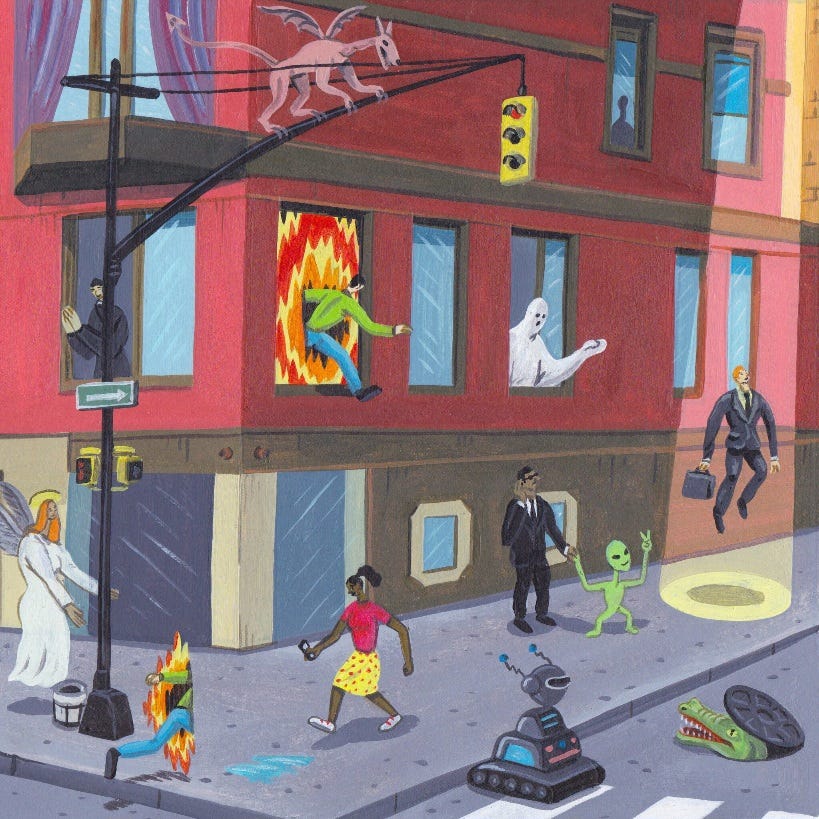
We are sliding back into the Middle Ages. In 2024, Tucker Carlson revealed that he had been physically attacked in his bed by a demon — “or by something unseen.” The entity left four claw marks on each of his sides and on his left shoulder, he said. He was bleeding when he woke. Catholic and Orthodox clergy weighed in publicly, with an Orthodox priest lamenting that Mr. Carlson’s Episcopalian faith left him ill-equipped to respond to such an attack. More recently, Gregg Phillips, the head of FEMA’s Office of Response and Recovery, made news for claiming that he had once been teleported, by forces beyond his control, to a Waffle House 50 miles away in Rome, Ga. The Times sent a reporter to track down the workers and regulars at all three of Rome’s Waffle House locations, but nobody remembered Mr. Phillips. … (New York Times)
*More recently, Gregg Phillips, the head of FEMA’s Office of Response and Recovery, made news for claiming that he had once been teleported, by forces beyond his control, to a Waffle House 50 miles away in Rome, Ga* what happens in US, stays in US. I was seriously worried he was talking about Rome, Italy