
Suggested Readings
A few recommendations by Figs in Winter for your reading pleasure
Stoicism and emotion. One of the most common popular ideas about Stoicism is that the Stoics deny the value of emotions. This might be formulated in a number of different ways – the Stoics repress their emotions, or reject them, or overcome them – but the shared idea behind these different ways of putting it is that the Stoics think the emotions are not important for a good life. Indeed, not only are they not important, they are in fact an impediment to living a good life. That’s a common view. Equally common is the objection that this Stoic attitude towards the emotions is deeply unattractive. This objection might also take a number of forms: a healthy human life must involve a healthy emotional life; the emotions are an essential part of what it means to be a human being; denying or repressing emotions will only generate longer-term negative consequences; the emotions (anger in the face of injustice, for instance) are valuable insofar as they spur us on to act in positive ways; and so on. … (Stoicism Today)
The 2-step “loci method” for memorizing absolutely anything. You sit at a card table and a dealer lays out ten cards face up. He puts them back into the deck. Could you remember which cards you saw? What about in sequential order? In 2002, Dominic O’Brien earned a Guinness World Record for reciting a sequence of 2,808 cards (or 54 decks) after seeing each card only once, making just a few errors in the process. That probably sounds like an impossible cognitive feat if you’re the kind of person who has trouble remembering where your car keys are. But for World Memory Champions like O’Brien, it’s routine fare. These so-called memory athletes can memorize stunningly large numbers of things: Rajveer Meena correctly recited 70,000 digits of pi. Ryu Song I was able to memorize 4,620 random numbers in an hour. And Katie Kermode memorized 224 unfamiliar names and faces in 15 minutes. What’s the secret? … (BigThink)
Are morally good people any happier or sadder than others? Most of us have experienced both how good it can feel and how hard it can be to do the right thing. Helping strangers or supporting a friend can leave you with a deep sense of satisfaction at making a difference in someone’s life. But you’ve likely also felt the strain of showing up for others when you’re already stretched thin, or the discomfort of being honest about a difficult truth. In other words, being good is sometimes uplifting, and sometimes it’s a bit of a drag. These ordinary moments speak to a puzzle that philosophers have long debated: are moral people happier? Or is there some tradeoff between doing good and feeling good? … (Psyche)
Richard Dawkins and the Claude delusion. This is one of the sadder essays I have ever had to write. Richard Dawkins, bestselling author of The God Delusion, is a brilliant man, and a brilliant writer, and I have long admired him. But everybody has a bad day, and he just had his. … (Marcus on AI)
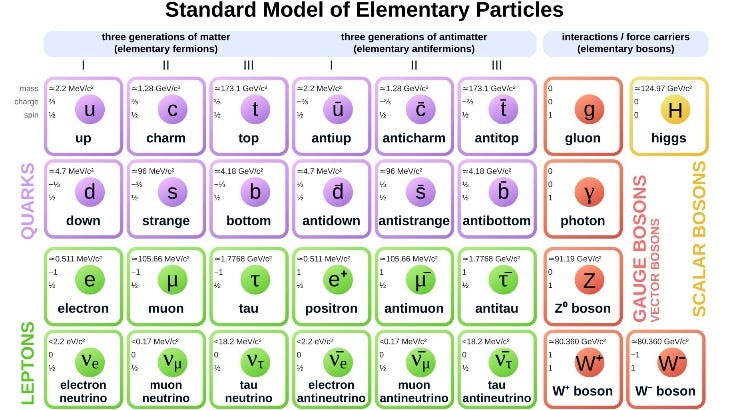
The particles in the early Universe painted a different picture. An amusing and insightful collaboration between BigThink and Starts with a Bang to bring you all of modern fundamental physics in 20 images and very few words. Enjoy, and good luck! … (BigThink)
Aaaacckk--my list is way too long already. Seriously--thanks!
In your essay re Dawkins, you write:
"And there is no reason to think that Claude feels anything at all. I am sure Claude can draw on its training data to wax poetic about orgasm, but that doesn’t mean it has ever felt one."
I would go much further and phrase this: And there is total reason to think that Claude cannot feel anything at all. I am sure Claude can draw on its training data to wax poetic about orgasm (or any other emotion), but that doesn’t mean it has the biological/biochemical basis to have ever felt one.