
Suggested Readings
A few recommendations by Figs in Winter for your reading pleasure
Your followers might hate you. Everybody knows the problem with the feedback system of social media sites. The system of likes, reposts, restacks and the like encourages mobbing, clickbait, and other bad behaviour. Jonathan Haidt talks about this in an Atlantic article. One of the engineers at Twitter who had worked on the “Retweet” button later revealed that he regretted his contribution because it had made Twitter a nastier place. As he watched Twitter mobs forming through the use of the new tool, he thought to himself, “We might have just handed a 4-year-old a loaded weapon.” … (Small Potatoes)
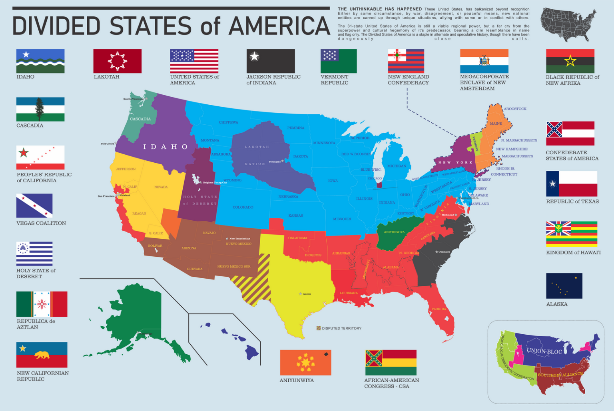
America’s post-apocalyptic maps reveal eerily familiar fault lines. The United States has ended, but America continues. The question is: How? That’s the shortest possible summary for an entire genre of U.S.-centered, post-apocalyptic fiction. Call it “America after the Fall.” It’s a fertile genre, with plenty of maps to illustrate its dismal point. That point is not the future, but the present. Like other strands of sci-fi, post-apocalyptic fiction projects onto tomorrow the anxieties of today. And these maps of a catastrophic future are present-day America’s long, hard look in the mirror. … (Big Think)
Functional Medicine is still bullshit. It’s been a few years since I last wrote about Functional Medicine at Skeptoid, but it reared its ugly head again the other day when I was at the dentist. Another patient was at the front desk asking — nay, demanding — some Functional Medicine version of dentistry. The poor front desk clerk had no idea what this person was talking about. I did. I had to roll my eyes and bite my tongue — which was easy since half my face was dead with Novocaine. Functional Medicine (FM) is an alternative medicine system that employs fear-based marketing to scare you away from medical doctors. … (Brian's Bullshit-Free Zone)
Is it irresponsible for academics to refuse to use AI? On Facebook, the philosopher N. Ángel Pinillos (Substack) commented on the new AI policies of the journal Ethics. “I thought that the goal of scholarship is to produce the highest quality academic content. However, many of my colleagues who I respect seem to think that the goal is something more complicated, they endorse things like that it is preferable that the content be fully produced by humans without help from AI. (Ethics seems to have this policy). I’m trying to understand this perspective. Consider a medical journal that does not publish a paper because it was made by AI, although the paper contains the cure for a deadly disease and would be published if it was made by a human. I assume everyone would think that the academic journal has made a grave error. So what’s the difference between this case and philosophy (or related fields)?” Ángel considers an extreme version in which AI writes the paper itself. I want to change the case a bit. Suppose a human remains the author, but AI helps write the paper—it’s involved in brainstorming ideas, clarifying arguments, identifying the relevant literature, anticipating objections, tightening prose, and so on. Is there anything wrong with this? … (Small Potatoes)
3 philosophical debates from the 20th century that neuroscience is reshaping. Philosophers and scientists have always kept close company. Look back far enough, and it’s hard to tell where one ends and the other begins. Before we had instruments to measure reality, we had to reason our way into it, but that intellectual lineage is what eventually gave us the scientific method. As technology advanced and the scope for observation expanded, specializations splintered off from philosophy to reconstitute as the sciences. … (Big Think)
These are all relevant topics.
My two cents on two points:
“Alternative medicine” is a slippery slope, and if the science doesn’t back it then you’re only left with a positive placebo effect—if you’re lucky! Prevagen advertised on the CBS Evening News (my old job) made me ashamed.
I often use AI because of my disability typing and after returning to university I discovered it is a wild Mustang. You better know how to ride before using it!
I learned the hard way with hand scarred in the fire suggesting to a professor to read something. Boy, did I learn! Fortunately, I am the better for it—and actually have a closer relationship with the professor.
It’s simply a research tool that must be questioned dozens of times like a detained suspect in police questioning. I always throw back it what it already said whether right or wrong. If I find contradictions it goes in the doghouse and is questioned 20 more times.
Eventually, I find, I get “closer” to the truth, and I back my belief by reputable sources that I am required to read, too. I write the paper myself from scratch and may occasionally use it as an assistant for date facts on stuff I already learned.
In reality it’s getting more from me than I from it. It’s needs to be a research tool only.
Really liked the Big Think article…I’d be curious if you had anything to say on the breakdown of the free will/determinism section.