
So, what exactly is wrong with the Enlightenment?
Post-modern criticism and the dangers of anti-rationalism
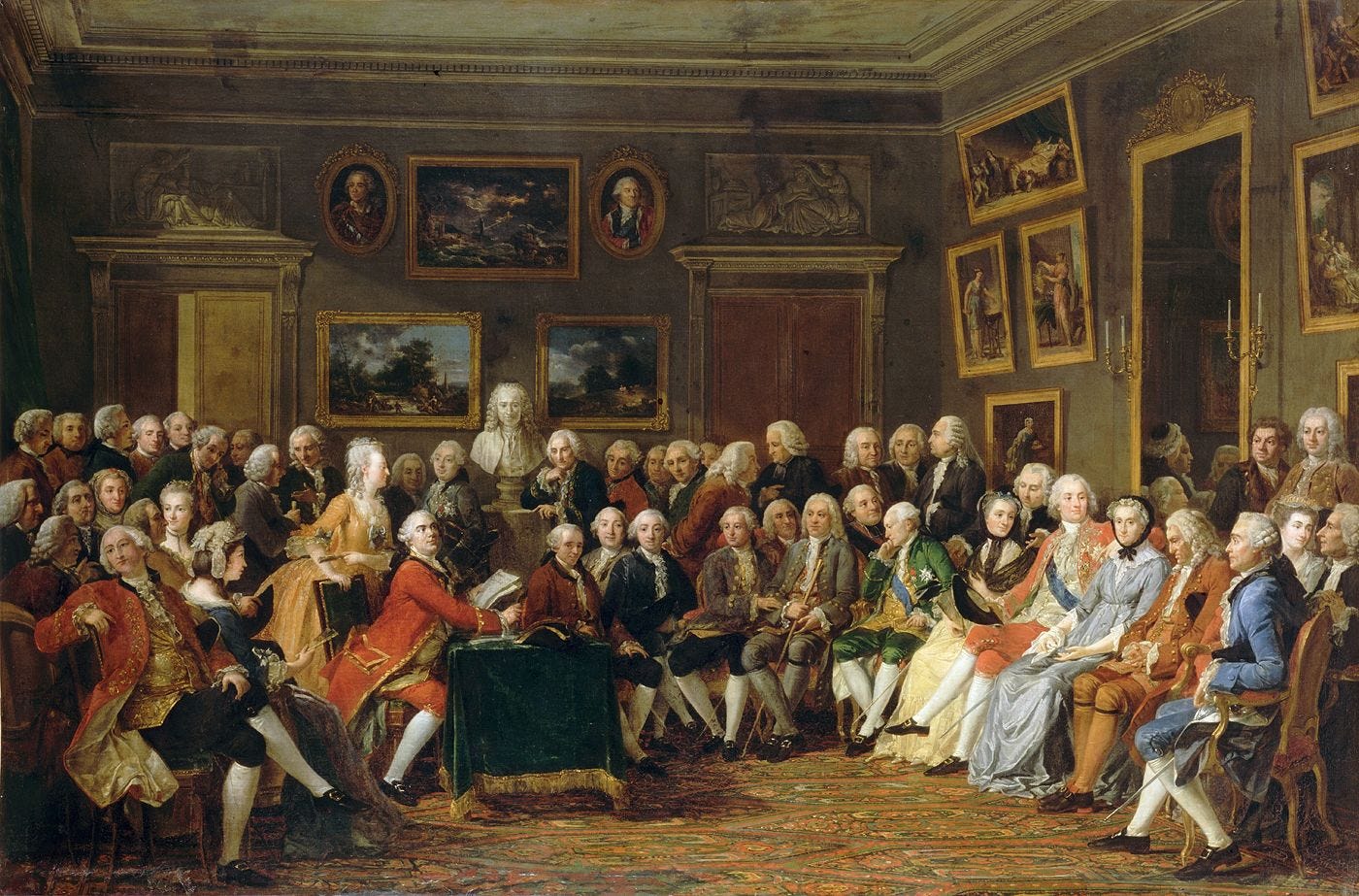
You might have heard that the Enlightenment, the period of European intellectual history that goes roughly from the late 17th to the early 19th centuries and that featured figures like Voltaire, David Hume, Denis Diderot, Immanuel Kant, and a host of others, was one of the worst things ever devised by human mind, directly responsible for all sorts of evils, first and foremost Colonialism (which, bizarrely, actually began in the late 15th century, two hundred years ahead of the Enlightenment—if your bullshit detector is already on yellow alert it means that it’s working well).
(Also, never mind that colonialism is pretty much a universal feature of human history, cutting across times and cultures, not just a European hobby. It covers everything from ancient Egypt, Rome, and China to 20th century Japan by way of the Mesoamerican empires. But that’s another story for another time.)
When I first studied the Enlightenment in school I thought it was one of very few periods in human history in which our species almost saw the light. Other examples from Europe include Classical Greece (5th and 4th centuries BCE) and the Renaissance (15th and 16th centuries CE). Outside of the old continent, we can think of the Classical Maya period (250-900 CE), the Gupta Empire in India (4th-6th centuries CE), the Tang Dynasty in China (618-907 CE), Heian Japan (794-1185 CE), the Islamic Golden Age (8th-13th centuries CE), and a few others. But of course just because a given period represented a momentary peak in human civilization it doesn’t mean there wasn’t a lot of crap going on at the same time in the same places. And that’s true for all the examples just mentioned.
Nor I am naive enough to defend everything that any given figure of the Enlightenment (or of any other period) has said or done. Voltaire was a great thinker, but by all accounts also a pretty serious son of a bitch. David Hume, one of my favorite philosophers, was also very clearly a racist, though he thought he had empirical evidence to show the inferiority of certain groups (he was wrong).
Nevertheless, I find it both instructive and, frankly, slightly encouraging, to contemplate the above mentioned periods as well as the individuals that were part of them and made them possible in the first place. Which is why I get seriously annoyed by what I perceive as exaggerated criticism of the Enlightenment in particular. (Not as many people seem hell bent on putting down the Renaissance, let alone the Maya civilization or the Islamic Golden Age.)
So I propose to take a look at the major criticisms moved against the whole notion of the European Enlightenment and then see whether they stand up to scrutiny. Spoiler alert: mostly they don’t, though the critics do make some good points that we shouldn’t cavalierly dismiss.
The Leftist critique of the Enlightenment
So far as I’m aware the major critiques to the Enlightenment have come from what we can broadly call “the Left,” both in Europe and in the United States. There are several interconnected arguments that have been proposed, but a major one is based on the alleged link between instrumental reason and domination. Max Horkheimer (1895-1973) and Theodore Adorno’s (1903-1969) influential book, Dialectic of Enlightenment, published in 1947, argued that Enlightenment rationality, initially liberating, soon transformed into “instrumental reason”—a calculating, dominating logic that reduces everything to objects of control. The two authors saw this transformation as leading to both the Holocaust and mass consumer culture.
Relatedly, Left critics see a nexus between power and knowledge. The French philosopher Michel Foucault (1926-1984) argued that ostensibly neutral knowledge systems (like medicine, psychology, or criminology) actually function as mechanisms of social control of undesirable people. In works like Discipline and Punish: The Birth of the Prison (1975), he concluded that institutions inspired by the Enlightenment create “docile bodies” through surveillance and normalization rather than liberation.
I have already mentioned the third objection, the connection between Enlightenment and colonial violence. Here the lead author was arguably Edward Said (1935-2003), who wrote the highly influential book Orientalism (1978), where he claimed that Enlightenment scholarship about the “Orient” actually served imperial domination. Postcolonial theorists like Gayatri Spivak (b. 1942)—a translator of the postmodern French author Jacques Derrida—and Homi Bhabha (b. 1949) extended Said’s approach, arguing that universal Enlightenment categories erased indigenous ways of knowing and justified cultural genocide.
Finally, we have the classic postmodern criticism of grand narratives. The French sociologist Jean-François Lyotard (1924-1998), for instance, argued that the Enlightenment’s so-called “metanarratives” of progress, reason, and emancipation mask relations of power and exclude alternative forms of knowledge, particularly local and traditional wisdom.

In defense of Enlightenment values
Pretty damning, no? Let’s see what a moderate supporter of Enlightenment values, such as myself, could possibly say in response.
