
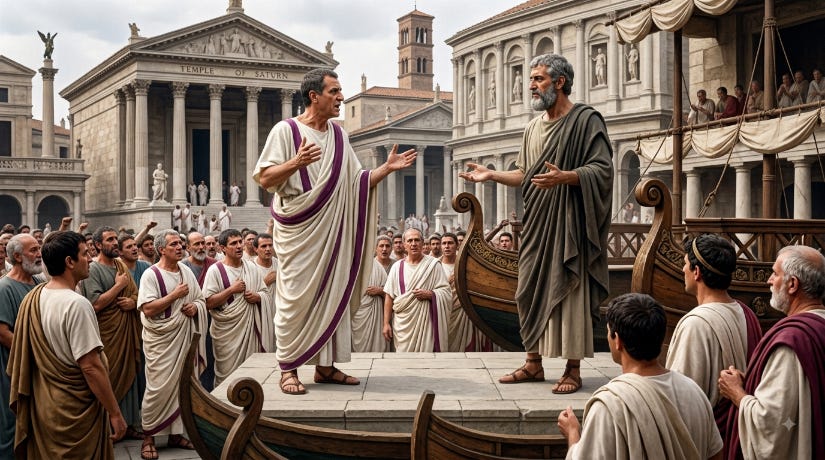
My occasional Stoic Camp student, Doug Bates, a follower of Pyrrho, has written a scathing attack on Academic Skepticism, the subject of my latest book. I asked my guide for the book, Marcus Tullius Cicero, to please write a response to Doug. Here it is.
Let me begin with a concessio, granting Mr. Bates two of his points. First, he is right that the word I used to render my colleague Carneades’s crucial concept of pithanon (more on this later), that is, probabilis, did not mean for me what moderns understand by “probability.” The statistical reading is an anachronism, and translators who have adopted it have done damage. The two concepts are of course related etymologically, but conceptually what we members of the New Academy proposed was a multi-step process to assess the truth-likeness of an impression, not a mathematical-quantitative approach.
Second, Mr. Bates is also correct that the philosophy of the New Academy does not lead to tranquillity, or ataraxia. We never promised that, as it simply isn’t what we value in life.
That said, much in the essay to which I am responding follows from a single unexamined premise: that a theory of assent must be judged for its efficacy as therapy. Since I reject that premise, Mr. Bates’s argument utterly collapses.
Let me expand on this particular point, as it is crucial. The philosophy of the New Academy, what you moderns call “Academic Skepticism,” is an epistemic stance, not what the Greeks called a bios, that is, a form of life. We derived our bios, of course, from Platonism. After all, Carneades, Philo of Larissa, myself and others were members of the Platonic Academy, although in my personal case – as I have written in several of my treatises (e.g., De Officiis 1.6) – I inclined toward the Stoic version of what you refer to as virtue ethics. In a sense, then, Mr. Bates has convicted a hammer of being a poor chair. Guilty as charged, I suppose!
Mr. Bates gleefully cites Epicurus against my philosophy: “Empty is the argument of the philosopher which does not relieve any human suffering,” aiming the charge at my philosophy. But the quote is question-begging: it assumes that relief of suffering is the sole measure of philosophy, which it clearly isn’t. Moreover, on closer inspection, it is false to the case, since rash assent, which I am counseling people to avoid, turns out to be a principal cause of human misery. Accordingly, my De Divinatione ends by demanding that superstition be torn out by the roots (2.72), which would relieve suffering at a civic scale not by consolation but by refusing assent to nonsense.
Our Pyrrhonist friend accuses me of a number of specific things in his diatribe: incoherence, the alleged emptiness of the pithanon criterion, what we might call the vanity of provisionality, the fact that not even my friend Massimo declares himself a Skeptic, and finally the charge that my character and reputation are pretty bad. Let’s examine each of these charges in turn.
First, the notion that Academic Skepticism is incoherent because it is self-refuting, I raised the question myself in my Academica and answered it then and there (2.34): the Academic does not assert “nothing can be known” as dogma. Rather, he reports what strikes him as persuasive, and applies the criterion reflexively.
To put it otherwise, Mr. Bates conflates two claims: (a) there is no truth, and (b) there is no criterion of the Stoic kind, no impression that certifies its own veracity (the so-called katalēpsis). We deny only the existence of kataleptic impressions. Truth may exist in abundance, for all we know, what we lack is a self-authenticating mark of it. The two positions are not in tension, let alone incoherent.
To make things more interesting, the charge falls with equal or greater force on Pyrrhonism. Sextus Empiricus and his ilk utter phrases like “no more this than that,” “I determine nothing,” “everything is undetermined,” “to every argument an equal argument is opposed.” Each invites the same argument Mr. Bates aims at the Academy: if nothing is determined, is that determined? If every argument has an equal opposite, does that apply to itself? A Pyrrhonist pursuing this objection is sawing the branch beneath himself.
Second, let’s get back to the pithanon, the criterion for assessing impressions proposed by Carneades. As I said before, Mr. Bates is right when he points out that this cannot be interpreted in terms of the modern concept of probability, despite my own choice of the word probabilis to translate it into Latin. But from “not statistical” it doesn’t follow, as the Pyrrhonist seems to think, “merely persuasive-sounding.”
Carneades – according to Sextus Empiricus, our major source for this – proposed a graded scale whereby an impression can strike us as apparently true (the lowest grade), convincingly true, “undiverted” (meaning, coherent with everything else we know about the matter), or thoroughly explored (the closest we can come to secure judgment, or what a modern would recognize as a well-tested scientific result). This is a procedure of cross-checking our judgments against the evidence, not just a rhetorical flourish. Each rung is a mechanism for catching the errors of the rung below, and the graded scale represents a major step forward in the history of epistemology.
What Carneades and other members of the New Academy proposed was an embryonic version of what modern epistemologists call fallibilism, an approach that takes for granted that one could be wrong and yet establishes a sliding empirical criterion (the pithanon) to use as a guide to arrive at the best possible judgment given any particular set of circumstances.
Mr. Bates also complains that to say that Carneades essentially proposed a non-quantitative version of what later became known as Bayesianism doesn’t help the Academic Skeptic’s case because Bayesian priors (the starting point for that method of analysis) are subjective. But this isn’t much of an objection for two reasons: (i) the merits of a proposal can only be assessed against the merits of alternative proposals, and here the Pyrrhonist has nothing at all to offer; and (ii) many contemporary philosophers of science agree that probabilities (of which priors are an instance) are inescapably subjective, because they are best understood as an estimate of the strength of our beliefs given the available evidence. In other words, as the saying goes, this is a feature, not a bug.
As an alternative to such a rigorous and reasonable approach the Pyrrhonist fallback – appearances, custom, laws, the arts – hands the criterion to local convention. Which of the two philosophies do you think is better fitted to flattering power, another one of Mr. Bates’s complaints?
The third charge put forth against me is that provisionality of judgment as advocated by the New Academy is kayfabe. Here I venture to say that the psychological claim proves too much. Confirmation bias, brought up by Mr. Bates, afflicts every epistemology equally, Pyrrhonism included: the man who congratulates himself on his ataraxia is not obviously less vain than the man who congratulates himself on the provisionality of his judgments.
Mr. Bates mentions the research of Philip Tetlock, who showed that people who are good at holding their opinions in check are rare. But this cuts the other way from what is intended: calibration, updating, and the deliberate entertaining of opposing views are the Academic method operationalized, and Tetlock research shows that the disposition is trainable, which means we should all learn from the Academics and improve our ability to suspend judgment when it is truly warranted.
The Academic never relied on individual virtue, but rather on arguing both sides, out loud, before opponents. That is an institution, not a self-report, and its descendants are the courtroom, the dialogue, peer review, and the controlled experiment. Modern science has been defined as a kind of organized skepticism, but not of the Pyrrhonian kind!
The fourth charge is meant to be ironic, though not in the sense Mr. Bates seems to think. He says that even my student, Massimo, who wrote a whole book about my philosophy and life, refuses to consider himself a Skeptic in the Academic sense and merely says that he is a skeptical Stoic.
This is a non sequitur, and the essay’s neatest self-inflicted wound. That’s because Academic Skepticism is a stance and not a sect, so “skeptical Stoic” is not apostasy, it’s the intended use! Mr. Bates has offered Massimo’s position as evidence against the thesis when it is in fact the thesis’s best illustration.
Finally, let me address the attempt at character assassination, which at least is not a real murder, like the one perpetrated by Mark Antony against yours truly!
Bates uses ad hominem (notoriously, a logical fallacy) to prop up his hasty generalization (another fallacy!), all on the basis of a sample size of one: since Cicero, he claims, had a corrupt character, it follows that Academic Skepticism is a bad philosophy. Just imagine using the same argument with any other philosophy or religion and you’ll immediately see the problem.
But what is Mr. Bates’s evidence that I’m such a despicable individual? He quotes Plutarch’s biography of me, a source writing a century and a half century later. Still, Plutarch was right that I had a penchant for self-promotion, and indeed I openly admitted so to my friends, it’s part of the public record. This was indeed one of my character flaws, perhaps excused in part by the fact that as an outsider to the Roman aristocracy I had to constantly remind my colleagues in the Senate that my contributions to the commonwealth were worth paying attention to. But by the end of his comparison of my life with that of the Greek orator Demosthenes, Plutarch himself rates me as more incorruptible than my fellow orator.
Yes, as Mr. Bates says, on the basis of Plutarch’s writings, I went to Delphi, and yes, I asked how to become most illustrious. I was twenty-three, and I will not pretend otherwise. What the Pyrrhonist omits is the answer I received, which was not a recipe for fame but a rebuke of the question: follow your own nature rather than the opinion of the multitude. Which I did, throughout my life. Do you ask for an example? Early on in my career I defended a client against a favorite of the dictator Sulla, thus risking my life for the pursuit of justice. Hardly the doings of someone who puts fame ahead of everything, don’t you think?
Furthermore, when I famously said “cedant arma togae,” let arms yield to the toga, Mr. Bates reads vanity where the line states a constitutional principle: civil authority over military. I’d like to remind you that I was proscribed and killed for holding it.
The Pyrrhonist also quotes my De Officiis 1.148, on the Cynics: “Indeed the reasoning of the Cynics must be rejected absolutely; for it is inimical to a sense of shame, without which nothing can be upright, nothing honorable.” But the rejection is of shamelessness, not of their critique of vanity, which I actually endorse where I say that love of glory is a danger (De Officiis, 1.68).
Another passage excerpted by Mr. Bates is found in my Pro Sestio (10.23) where I appear to endorse the pursuit of fame and status for their own sake. But the bit in question comes from a forensic speech, where I was clearly ventriloquizing an enemy. He errs badly who takes the opinions in our court speeches for our settled convictions. To cite prosecution rhetoric as philosophical doctrine is the very rhetorical trick the essay claims to deplore.
Yet another passage is then brought up, from Tusculans 1.17, which reads: “By Hercules, I prefer to be wrong with Plato, whom I know how much you esteem, and whom I admire myself, from what you say of him, than to be right with those others.” To which I replied: “I commend you; for, indeed, I could myself willingly be mistaken in his company.” But the context was a discussion of the soul’s immortality, where my utterance was meant as a courtesy, which is proven by the fact that afterwards I examine the question at length from both sides. Next time, read the next twenty sections, don’t stop at whatever fits your prejudices and call it a day.
There is also, if I may, a clear and decisive counterexample to Mr. Bates’s portrait of my character, in the Somnium Scipionis, which is found in the sixth book of my De Re Publica. It has been regarded as the most powerful ancient deflation of earthly glory – fame as a speck, on a speck, in a moment – written by the man Mr. Bates says organized his life around fame.
And in my speech Pro Archia (26) you will find my own open admission that we are all drawn by love of praise, but candor about the passion is evidence of self-examination, not of concealment.
At any rate, even were the portrait that Mr. Bates paints of me accurate, one vain adherent damns a method no more than Epicurus’s birthday cult damns hedonism or the Garden’s reverence for the Master damns ataraxia.
So far I have readily conceded what Mr. Bates gets right and I have then rebutted, I think convincingly, all his major points. Let me close by putting forth a positive case for the New Academy.
What the stance actually delivers is summarized in my De Natura Deorum, where I write: “Those who desire my own private opinion on every particular subject have more curiosity than is necessary. For the force of reason in disputation is to be sought after rather than authority, since the authority of the teacher is often a disadvantage to those who are willing to learn; as they refuse to use their own judgment, and rely implicitly on him whom they make choice of for a preceptor.” (1.5) In other words, weigh reasons, not authorities. Does that sound “dogmatic” to you? Is this not an anti-ego principle, the opposite of what is alleged?
Mr. Bates claims that Academic Skepticism is neglected as a philosophy of life. But such neglect should not be confused with irrelevance; its lineage is impressive: Augustine argued with it, Montaigne and Gassendi revived it, Hume inherited it, and modern fallibilism (and therefore science at large) is its grandchild.
Again, Mr. Bates is right when he says that our approach does not lead to tranquillity, but a philosophy that makes calm the highest good must trade truth for calm whenever they conflict. The Academic accepts discomfort as the price of not deceiving himself.
Also notice that the essay that so harshly criticizes me and my fellow Academicians itself assembles evidence, weighs persuasiveness, argues one side against another, and closes with a provisional prediction. Not one judgment in it is suspended. Mr. Bates cannot even attack the Academy without borrowing its instruments – which is, at last, the strongest evidence available for their usefulness.
Very creative and wonderful. It’s fun to hear Cicero “speak” again!
Nice use of the word kayfabe.