
On family affection
The Discourses of Epictetus, 1.11
This is an ongoing series on Epictetus’s Discourses, a book that literally changed my life and that, I think, is grossly underestimated nowadays, despite Epictetus’s major influence throughout the Middle Ages up to the Enlightenment and the founding of the American republic. Read what follows with an eye to its practical applications, the Master would have thrown you out of his school if he thought you were doing philosophy as a purely theoretical exercise! In these essays I’m using Robin Waterfield’s annotated translation. Two good public domain translations are collected in the Delphi Classics edition. Previous entries can be found by consulting the Figs in Winter Index.
_____
One day a government official stopped by Epictetus’s school in Nicopolis, on the northwestern coast of Greece. They exchanged pleasantries and then the philosopher asked his guest if he had a wife and children. That simple setup leads to one of the most profound and practically useful sections of the entire Discourses, and one of my personal favorites.
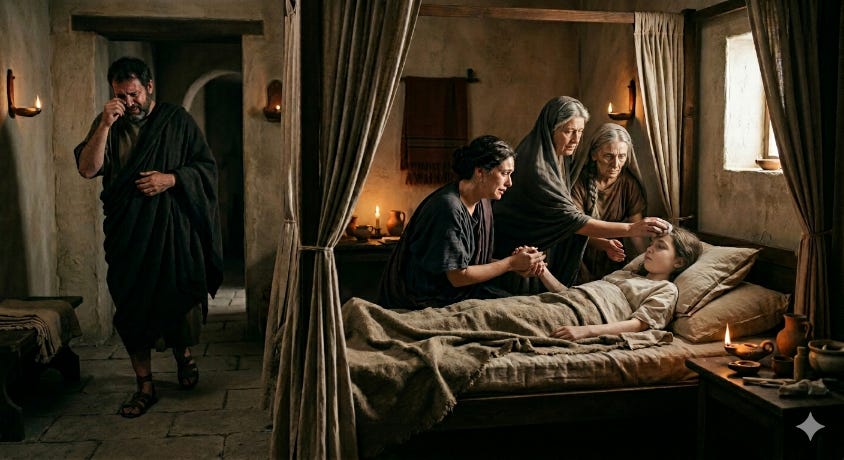
The visitor replies that he indeed has a wife and children, but, you see, that’s precisely the problem. His children make him miserable. Recently, for instance, his daughter was sick and he just couldn’t stand her suffering, so he had to leave the house, going back only once he was told that his daughter was all right.
Epictetus, evidently perplexed by this story, asks the father if he thinks his behavior was right, to which the poor wretch responds that it was natural.
“’For my part,’ said Epictetus, ‘I don’t dispute that that’s what happens, but the point at issue is whether it’s right. You see, on your way of thinking, you’d have to say that tumors are good for the body, just because they happen, and, to generalize, that mistakes are natural, because most of us -- almost all of us, in fact -- make mistakes. What you have to show me, then, is how your behavior was in accord with nature.” (1.11.6-7)
Epictetus here makes two crucial distinctions, which will soon turn out to be equivalent: on the one hand, between what is right and what is natural; on the other hand, between what is natural and what is in accord with nature. Let’s unpack this carefully, because confusing these notions, especially the latter two, is the source of much trouble, not just for aspiring Stoics, but for humanity in general.
First, then, the distinction between what is right and what is natural. The father’s distress at his daughter’s sickness is certainly natural, and it may therefore be understandable that he felt compelled to leave her side as a result. But leaving one’s sick daughter is certainly not right, because it is the duty of a father to stay and provide comfort to his children (for Epictetus on role ethics see the book by Brian Johnson). The bottom line is that it is crucial to keep in mind the distinction between one’s duties -- however unpleasant they may be -- and one’s feelings. The duties should override the feelings: even if you feel very uncomfortable doing what is right, you ought to do it anyway.
Second, the distinction between what is natural and what is in accord, or agreement, with nature. These may sound like the very same thing, and it is precisely this confusion that is the source of a major misunderstanding about Stoicism. We have already seen what is natural. What is in accordance with nature, by contrast, is to live prosocially and by the light of reason. Why? Because nature has made us highly intelligent social beings. Just like it is in the nature of a plant to seek water and light, so is in the nature of Homo sapiens to think through problems and to cooperate with fellow members of their species.
