
On contentment
The Discourses of Epictetus, 1.12
This is an ongoing series on Epictetus’s Discourses, a book that literally changed my life and that, I think, is grossly underestimated nowadays, despite Epictetus’s major influence throughout the Middle Ages up to the Enlightenment and the founding of the American republic. Read what follows with an eye to its practical applications, the Master would have thrown you out of his school if he thought you were doing philosophy as a purely theoretical exercise! In these essays I’m using Robin Waterfield’s annotated translation. Two good public domain translations are collected in the Delphi Classics edition. Previous entries can be found by consulting the Figs in Winter Index.
_____
To be content seems like a rather modest objective in one’s life. In our hyper-competitive, ultra-consumeristic, celebrity-obsessed culture we are taught never to be content, that’s for losers! What we should want instead is to crush the competition, to acquire ever more stuff, to become famous regardless of whether there is any substance to what we do.
That’s why it’s so refreshing to pay attention to the Stoic Epictetus, a slave-turned-teacher who understood much about what makes for a good life, and who today is decidedly counter-culture, subversive, even.
In section 12 of the first book of his Discourses, Epictetus addresses the issue of contentment, but begins in a rather odd place:
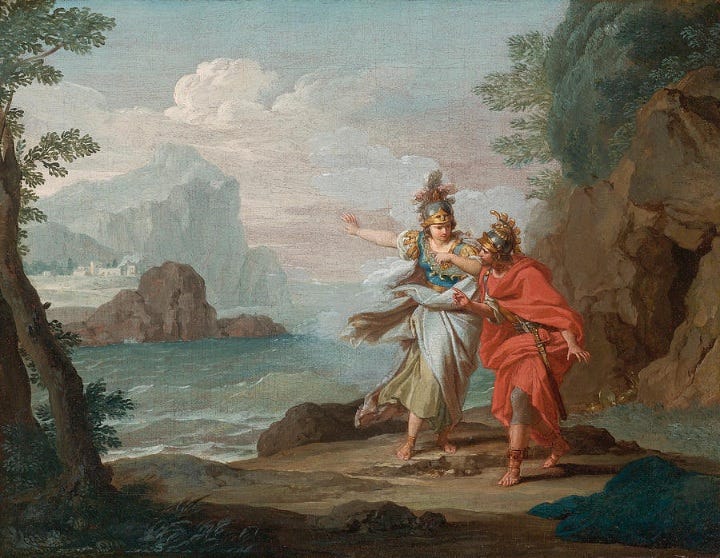
“On the subject of the gods, there are some who deny their very existence, and others who admit their existence, but say that they’re ineffective and don’t exercise any care or forethought. A third group admits both their existence and their providence but only with regard to large-scale, heavenly phenomena, not to anything that happens on earth. A fourth group claims that they also take thought for things on earth and human affairs, but only in a general way, and that their providence doesn’t apply to individuals. Then there’s a fifth group, among whom are Odysseus and Socrates, who say, ‘Nor am I hidden from you as I go on my way.’” (1.12.1-3)
What on earth is he talking about, and what does this have to do with contentment? He begins by listing a number of then (and now!) common positions about the nature of the gods. The second one, for instance, is typical of the Epicureans. Epictetus himself has a preference for the last entry, a view that he attributes to both Odysseus (who is quoted from Homer’s Odyssey while he is addressing Athena) and Socrates, both of whom were Stoic role models.
Epictetus explains immediately afterwards that he is trying to determine which of the above positions is the most sound because how can one live according to the gods, if one doesn’t understand the nature of the divine? To live according to the gods was a phrase used by a number of philosophers, including the Pythagoreans and the Platonists, though in the case of the Stoics it is often rendered with the more neutral “live according to nature.”
The Master concludes that: “After a thorough examination of these matters, then, a truly good person subordinates his intellect to the power that governs the universe.” (1.12.7) At this point, one of his students raises an objection: “But my wish is for everything to turn out just as I want it to, no matter what it is.” And he gets the predictable response:
“That’s insane! You’re out of your mind! … Look, how do we go about writing? Do I get to write the name ‘Dion’ in any way I like? No, I’m taught to want to write it as it should be written. And what about music? The same. What about in general, wherever some skill or expertise is involved? It must be the same, otherwise expertise would be quite worthless, if it changed according to every individual’s wishes. … Education consists precisely in learning to want everything to happen as it does happen.” (1.12.13-15)
This is a very insightful reply, and one that gets at the core of Epictetus’s philosophy. Freedom, he says, doesn’t consist in doing whatever one wishes, at random. It consists in making the best use of any given structure one operates within. If the structure is grammar, then we write “Dion” using the proper sequence of the four letters that make up the name; if the structure is musical notation, we write and play our music accordingly. If, finally, the structure is the world itself and the web of cause and effect that regulates it, we follow that as well. What happens if we don’t?
“You can’t stand hardship of any kind; you’re always dissatisfied. If you’re on your own, you call it loneliness, and if you’re with people, you say they’re schemers and thieves. You find fault even with your parents, children, brothers, and neighbors. When you’re on your own, you should call that peace and freedom, and think of it as a godlike existence; and when you’re in a crowd, you shouldn’t call it a mob or focus on the noise and discomfort, but think of it as a celebration and a festival, and so accept and be contented with everything.” (1.12.20-21)
People are never happy because they always look at the empty half of the glass. If they trained themselves to accept situations they don’t control as they come, they would not be so troubled. This is the Stoic application of a powerful concept in modern psychology, the framing effect. Bill Irvine wrote a whole book about it, in which he invites us to exploit the effect for our own benefit, turning it from a cognitive bias into a powerful tool for self-therapy.
Look carefully at the examples Epictetus provides to his students: if you are alone, don’t label the situation “loneliness” but peace; conversely, when you find yourself among others, don’t use the label “mob,” think of it instead as a festival! That’s what contentment is: not just a generic “think positively,” but an active reframing of what is happening in a way that is useful and more conducive to flourishing. Otherwise, says the sage from Hierapolis, you’ll be in prison:
“What prison? The one [you’re] in now. I mean, [you don’t] want to be where [you are], and any place where someone doesn’t want to be is a prison for him. That’s why Socrates wasn’t in prison, because he was there by his own choice.” (1.12.23)
Famously, Socrates had the opportunity, at his trial, to avoid the death sentence, but declined in order to make a point about the worth of what he had been doing for decades on behalf of the Athenian people. Later on, once in jail, he again had a chance to escape, since his friends had corrupted the guards. But he refused on the grounds that one should not obey the law only when it suits him. Therefore, he was there of his own volition, and thus not really in prison, despite appearances to the contrary. The broader point is explained by Epictetus shortly thereafter:
“Don’t you realize how small a part you are compared to the whole – in respect of your body, I mean: as far as your reason is concerned, you’re no worse than or inferior to the gods, because the greatness of reason is not assessed by length and height but by the quality of its judgments. … So for what have [the gods] made you accountable? Only for what’s up to you, which is the proper use of impressions. So why are you taking on things for which you’re unaccountable? You’re just making trouble for yourself.” (1.12.26, 34-35)
Our physical bodies are tiny and weak compared to the vastness of the cosmos, but our rational minds share with the divine, since reason can only be measured by the soundness of our judgments. And that, and only that, Epictetus concludes, is our business: to train ourselves so that we make the best use of our impressions. Everything else in life follows from that most crucial step.
“our rational minds share with the divine, since reason can only be measured by the soundness of our judgments.” Perhaps the Divine is within us as well, dwelling within our subconscious.
We should all raise our glasses--half full or not--to such fine essays. Thnx Dr P!