
In the media
A look at recent public appearances by yours truly
Here is another occasional installment of media appearances featuring, well, myself. Apologies for the presumption, but I imagine that—since you are subscribing to Figs in Winter—you may have at least a passing interest in what else I do and talk about. So here you will find links to recent interviews, podcasts, external articles, and other assorted media appearances featuring yours truly. Enjoy, I hope!
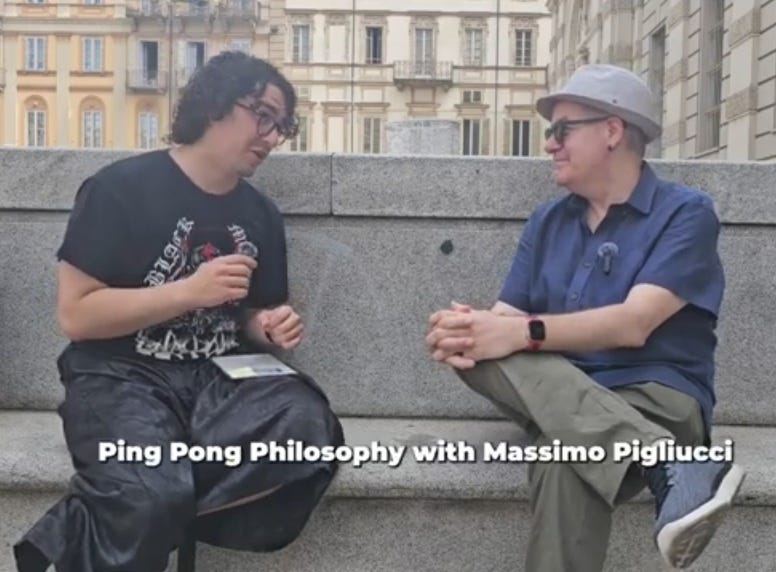
While in Turin (northern Italy) for a conference on logic and philosophy of science, I was interviewed by “Ping Pong Philosophy.” Here are my takes on: (i) Panpsychism: The view that consciousness, or at least some form of mentality, is a fundamental and ubiquitous feature of reality. On this view, even the smallest physical entities possess proto-conscious properties, though in rudimentary form. Advocates argue it avoids the “hard problem” of consciousness by rejecting a sharp divide between mind and matter. Critics object that it seems implausible to ascribe experience to simple particles and that it struggles with the “combination problem”: how tiny minds could combine into unified human consciousness. Despite controversies, panpsychism has seen renewed interest in contemporary philosophy of mind. Although it is not a popular position nowadays, it has some ardent defenders. You can learn more about in Panpsychism (Stanford Encyclopedia of Philosophy) by Phillip Godd, William Seager & Ssean Allen-Hermanson. (ii) Scientifically informed philosophy: A methodological paradigm that stresses the integration of empirical findings into philosophical inquiry. Rather than treating philosophy and science as isolated, it views them as mutually supportive: science provides data about how the world works, while philosophy clarifies concepts, evaluates methods, and reflects on implications. Examples include philosophy of mind drawing on neuroscience, or ethics engaging with evolutionary biology. Advocates see this as keeping philosophy relevant and rigorous, while critics warn against reducing philosophical questions to purely scientific ones. (iii) Science vs. pseudo-science division: The division between science and pseudo-science concerns how to demarcate genuine knowledge from unfounded claims. Philosophers like Karl Popper proposed falsifiability: scientific theories must be testable and open to refutation. Others highlight practices such as peer review, predictive power, and methodological rigor. Pseudo-sciences (e.g. astrology) often lack these traits, offering ad hoc explanations instead. The debate shows that no single criterion fully captures the boundary, but examining methods and openness to evidence remains central in distinguishing reliable science from imitation. (YouTube, 22’)
If you're not happy, it may be your fault! This is a very short video based on a chapter I contributed to “Too Weird to Believe, Too Plausible to Deny: Mind Blowing Philosophical Ideas.” The idea underlying my chapter is that, according to the Stoics, we are in charge of our happiness, properly conceived. (YouTube, 1’ 12”)
On pleasure, character, and doubt: a deep dive into Beyond Stoicism. Out of all the Greco-Roman philosophies, Stoicism is probably the most popular right now. But just because it’s the most popular does not necessarily mean it’s the most useful for everybody! The goal of Beyond Stoicism is to make more people aware of the rich variety of practical life philosophies that came out of the ancient Greek and Roman worlds and help contemporary readers get a basic idea of how they can apply these philosophies to their contemporary lives. … (Plato's Academy Centre)
Why Cicero matters: a mini-symposium. Why Cicero Matters shows us how the Roman philosopher and statesman Marcus Tullius, better known as Cicero, can help realize a new political world. His impact on humanitarianism, the Enlightenment and the Founding Fathers of America is immense. Yet we give Julius Caesar all our attention. Why? What does this say about modern politics and political culture? … (One of the contributions is by yours truly, Syndicate)
A conversation about Beyond Stoicism. I had a lovely chat with two young people from Indonesia about my most recent book, Beyond Stoicism--A Guide to the Good Life with Stoics, Skeptics, Epicureans, and Other Ancient Philosophers (co-authored with Greg Lopez and Meredith Kunz). Check it out! (YouTube, 1 hr 42’)
Thanks Massimo. On how Cicero matters, I learnt a while ago that Cicero's name still appears in modern Italian; as in “Grazie per avermi fatto da Cicerone oggi.” Not an Italian word quite yet, it has to lose the majuscule but it will come.