
In the media
A look at recent public appearances by yours truly
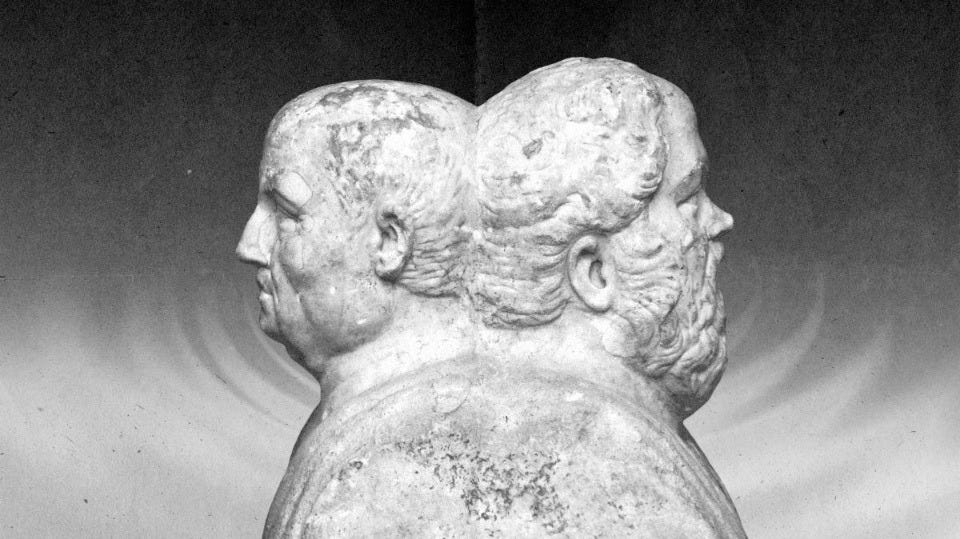
Here is another occasional installment of media appearances featuring, well, myself. Apologies for the presumption, but I imagine that — since you are subscribing to Figs in Winter — you may have at least a passing interest in what else I do and talk about. So here you will find links to recent interviews, podcasts, external articles, and other assorted media appearances featuring yours truly. Enjoy, I hope!
The Delphic injunctions. For hundreds of years during Antiquity people went on pilgrimages to the Oracle at Delphi in Greece, hoping for prophecies that would help them in their lives. This included everyone from kings to regular folks. Even today you can sense the attraction: I went to Delphi three times, and it really is a magical place even if one doesn’t believe in magic. One of my favorite stories about Delphi is a wonderful example of political genius dressed up as religious interpretation. In 480 BCE, with Xerxes’ massive Persian army already marching through Greece, the Athenians sent envoys to Delphi in near panic. The Oracle’s response was rather cryptic: she said that “the wooden wall alone shall not fall” and would protect Athens. … (Philosophy Now)
Forget Stoicism, Skepticism is the ancient philosophy we need today. If you haven’t read Marcus Aurelius’ Meditations, you’ve certainly heard of them — if not in school, then on Instagram, TikTok, or a podcast. Composed by the second-century Roman emperor in his tent on nights between long marches and bloody battles, they’re one of the foundational texts of Stoicism, an ancient philosophy that first emerged around 300 B.C., and which has recently found an unlikely second life on social media.
Stoicism’s modern-day resurgence has been traced back to viral marketing executive turned self-help author Ryan Holiday’s 2014 book The Obstacle Is the Way: The Timeless Art of Turning Trials into Triumph, which introduced snippets of Meditations to professional athletes and Silicon Valley elite. Other books from Holiday — including The Daily Stoic, which spawned a popular newsletter of the same name — followed suit, as did numerous copycats. Finding audiences outside college campuses, new editions of Seneca’s Letters from a Stoic and Epictetus’ Discourses also became bestsellers.
I am not surprised at Stoicism’s newfound popularity. A lot of Stoic ideas and ideals — including resilience in the face of seemingly unbearable hardship — emerged during times which, like our own, were marked by “chaos, turmoil, and major political and social changes.” When the world appears to fall apart, Stoicism promises a way to prevent yourself from falling apart with it.
But I also have a bone to pick with Stoicism, both the philosophy itself and its internet-age bastardization. That’s why, in my latest book, How to be a (Happy) Skeptic: The Power of Doubt in a Meaningful Life, I point readers to another ancient school of thought, one related to (yet not nearly as fashionable as) Stoicism, and which may be uniquely suited to deal with the problems we face today, both individually and as a society. … (BigThink)
Doubt, moral courage, and living without illusions. What does it mean to live well when certainty is unavailable?
Michael Shermer speaks with yours truly about moral character, ancient philosophy, and the difficult art of making decisions without easy answers. The conversation moves from Cicero and Stoicism to the legacy of the New Atheism, asking why rejecting religion is not the same as having a philosophy of life.
We discuss virtue ethics, moral dilemmas, effective altruism, faith, free will, democracy, human flourishing, and the uneasy relationship between facts and values.
From the trolley problem and Peter Singer’s drowning child thought experiment to the ethics of charity, the limits of utilitarian thinking, and the dangers of tribalism, this episode asks how we should act when rules fail, consequences are uncertain, and good intentions are not enough. … (Skeptic)
What Stoicism teaches us about Donald Trump, covid-19, and ghosts. I discuss Stoicism, its applicability to the world of modern politics, and even the possibility of ghosts existing.
What would Marcus Aurelius think of the modern political climate?
We tend to think of Stoicism as a philosophy of passive resignation -- but I argue that true agency requires recognising both the limits of our power and knowledge. For me, the Stoic dichotomy of control does not breed political helplessness, but actually equips us to combat systemic issues like climate change by focusing our energy on actionable steps.
A conversation with the Via Stoica. What does it mean to be both a Stoic and a skeptic?
In this episode of the Via Stoica Podcast, I return to discuss my new book How to Be a (Happy) Skeptic: a guide to building a philosophy of life rooted in Stoic virtue and the ancient art of proportioning belief to evidence.
The discussion moves from the foundations of a philosophy of life to the ancient debate between the Stoics and the Academic Skeptics, and then to one of the most compelling figures in Western history: Marcus Tullius Cicero. Not a Stoic himself, but deeply shaped by Stoic ethics, Cicero lived through the fall of the Roman Republic, exile, personal grief, and death at the hands of Mark Antony’s soldiers. His life, I argue, is a model for holding strong convictions while remaining honestly uncertain about what you know and why.
The episode also explores how Skepticism is not the enemy of commitment but its most honest companion: that our beliefs should be proportioned to evidence, and that a life examined with intellectual humility is not weaker but more durable.