
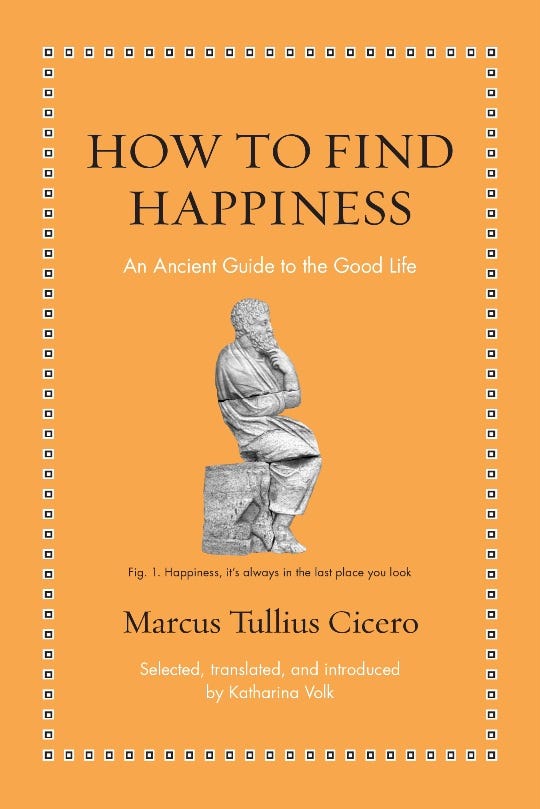
[Based on How to Find Happiness: An Ancient Guide to the Good Life, translated by Katharina Volk. Full book series here.]
I have a weakness for memorable book titles, and in that department I think it’s hard to beat Cicero’s De Finibus Bonorum et Malorum, On the Ends of Good and Evil. It also happens to be one of the books that have been most influential in my formation as a practical philosopher, so I was very happy to see a new (partial) translation of it being put out by Princeton University Press as part of their ongoing Ancient Wisdom for Modern Readers series. The translator is Katharina Volk, a professor of classics at Columbia University, who has agreed to be interviewed for my Ars Vivendi video series. So, stay tuned!
De Finibus was written by Cicero in 45 BCE, two years before his assassination, ordered by Mark Antony as a personal and political vendetta. The aim of the book is ambitious: to compare three of the major philosophical schools of the time and determine which one is closest to the mark if the goal is to live a life worth living – what the Greeks called eudaimonia and the Romans vita beata (blessed life).
The three schools in question are: Epicureanism, defended in the dialogue by Lucius Manlius Torquatus, a young man who had recently converted to the way of the Garden; Stoicism, represented by Cicero’s friend and colleague in the Senate, Marcus Porcius Cato (known as Cato the Younger); and syncretic Platonism (more on this in a moment), espoused by Marcus Pupius Piso.
The structure of De Finibus is an excellent example of skepticism in action: book I is devoted to a presentation of Epicureanism, which is followed by a criticism of the same philosophy in book II; then Stoicism is explained in book III and criticized in book IV; the same pattern repeats in book V, concerning Platonism, but both exposition and critique are contained in a single part. While the first four books feature just Cicero (who always takes the part of the critic) and one interlocutor, the last book has other people present: Quintus, Cicero’s brother (who, in De Divinatione, is characterized as a Stoic) and Atticus, Cicero’s lifelong friend and a committed Epicurean.

Such a structure did not come about by chance. As Volk points out, it reflects the skeptical method known as utramque partem disputare, arguing both sides. The idea is not that all positions are equally valuable, but rather that in order to arrive at a serious understanding of complex matters one has to make an effort to really grasp the various positions on offer. In modern argumentation theory, this is called the steelman approach: considering the strongest possible argument by your opponent, as opposed to the strawman, which is a logical fallacy whereby one attacks an easily defeatable caricature of someone else’s position.
Before we proceed to the substance of the dialogue, let me go back for a moment to the concept of eudaimonia, or vita beata. The idea is that a good life consists in deliberately acting in a way that is appropriate for a human being, given the sort of animal humans are. The underlying notion is that dogs are happy when they are free to behave as dogs, cats like cats, and so on, and that we are no exception. The question then becomes what is, in fact, “appropriate” behavior for a human being? That’s the quest for the summum bonum, the highest good, on which all Greco-Roman schools were focused.
Sure enough, the three schools examined in detail by Cicero in De Finibus can easily be separated according to their conception of the summum bonum: for the Epicureans it’s pleasure; for the Stoics it’s virtue; and for the Platonists it’s a combination of virtue and external goods (like health, wealth, reputation, and so forth).
The interesting bits, then, come about when we consider two issues for each of the schools: (i) is their chosen summum bonum really the one that works for human beings? (ii) What are their arguments in defense of their chosen position?
It is also important to note Cicero’s own stated position: he calls himself an Academic, so one might think he is aligned with what I have called syncretic Platonism, defended in the dialogue by Piso and articulated by Antiochus of Ascalon, who had been scholarch of the Academy until a couple of decades before Cicero wrote De Finibus. Antiochus defended a model according to which there was no major difference among Platonism, Aristotelianism, and Stoicism, which were seen as variations on the same fundamental theme of virtue and externals. Hence the term “syncretism” that I have attached to this view, today known as Middle Platonism.
However, Cicero repeatedly says in his writings that his allegiance goes to the New Academy of Carneades, that is, to what is nowadays known as the skeptical phase of Platonism. This is important in order to make sense of the fifth book of De Finibus.
Now that the stage is set, let’s go through the three schools as they are examined in the five books, beginning with Epicureanism. In book I, Torquatus gives a very clear (and enthusiastic!) defense of Epicureanism, arguing that it is Nature itself that clearly indicates that pleasure is good and pain is bad: that’s pretty much the universal preference among human beings, and it manifests itself since we are very young and cannot possibly be influenced by cultural norms (but see here). Torquatus also says that Epicureans do make use of the virtues, but only in an instrumental fashion: virtue is not good in itself, it is good because it aids us in avoiding pain and experiencing pleasure. In a similar manner, says Torquatus, Epicureans value friendship, but again in an instrumental fashion, because they derive pleasure from the company of friends.
In book II Cicero begins to dismantle the Epicurean construction, focusing on two points in particular: their definition of pleasure and their subordination of virtue to it. It turns out that, rather bizarrely, says Cicero, Epicureans think that the highest pleasure of them all is lack of pain. But that’s a very odd conception of pleasure, shared by no one outside of the Garden. As Volk says, “The Epicurean conflation of painlessness and pleasure is at best a conceptual muddle and at worst a bait and switch.” The second major criticism leveled by Cicero is that pleasure simply does not provide a sufficient impetus for action that benefits the common good: what we need is virtue above all, because virtue is reason-based pro-social behavior.
Book III shifts to Cato’s exposition of the Stoic system, one of the most complete and rigorous we have from the ancient literature, which means that anyone interested in Stoicism simply ought to read De Finibus. But don’t just read the third book; go on to the fourth one, where Cicero responds to Cato and raises a series of objections against Stoicism. The big one is that Stoicism is not really different from Aristotelianism, meaning that the Stoics endorse the same philosophy as the Peripatetics, just explained with a different and somewhat more obscure vocabulary.
Cato is taken aback, but Cicero explains: look, Aristotle said that virtue is a must, but that, in order to be happy, we also need a certain degree of external goods, like wealth, reputation, and the like. The Stoics, continues Cicero, claim that virtue is the only true good, but then admit that externals are welcome, under the strange rubric of “preferred indifferents.” Basically, it’s six of one and half a dozen of the other.
This is interesting for two reasons: first, Cicero’s tentative conclusion at the end of book IV seems to be that the syncretism of Antiochus is, after all, the way to go. Second, that same objection is raised even today against the Stoics by Neo-Aristotelians.
The “Stoicism is Aristotelianism rephrased” position, however, is founded on a fundamental misunderstanding of what the Stoics were saying. There is a not-so-subtle difference between arguing that eudaimonia requires both virtue and externals (Aristotle) and saying that, while externals are welcome if available, virtue by itself guarantees a life worth living (the Stoics). The first notion is inherently elitist, as not everyone will have access to externals, and that access comes, of course, in a huge variety of degrees. The second notion is democratic and universal: even if your life is afflicted by poverty, disease, scarce material support, and so on, it is still a life of dignity and very much worth living so long as you behave virtuously.
Finally, in book V Cicero tackles syncretic Platonism as advocated by Antiochus and defended in the dialogue by Piso. Cicero sticks to the skeptical approach and begins to poke holes in the notion that Platonism, Aristotelianism, and Stoicism are variations of the same fundamental philosophy. In the end, interestingly, Cicero says that while as a Platonist he should be sympathetic to Piso’s views, he finds the Stoic approach more convincing.
Nevertheless, the dialogue ends without a clear winner, so that readers can make up their minds on the basis of the arguments presented. Herein lies my only criticism of this booklet: the editorial decision not to include any material from book V, on the grounds that Antiochus’s doctrines are not well known today and that the conclusion (rather naturally) returns to some of the themes already discussed in previous books. I think readers would have benefited from getting a sense of syncretic Platonism as well as from the way Cicero handles the last part of the dialogue.
Still, as Volk writes at the end of her Introduction: “It is up to us to approve or disapprove of any of the ideas mooted in the five books of De Finibus or indeed, if we have a skeptical bent, to withhold judgment. What we should do, however, is philosophize. Only in this way can we find happiness.” Indeed.
[Previous installments: I, II, III, IV, V, VI, VII, VIII, IX, X, XI, XII, XIII, XIV, XV, XVI, XVII, XVIII, XIX, XX, XXI, XXII, XXIII, XXIV, XXV, XXVI, XXVII, XXVIII, XXIX, XXX, XXXI, XXXIIa, XXXIIb, XXXIII, XXXIV, XXXV, XXXVI, XXXVIIa, XXXVIIb, XXXVIII, XXXIX, XL.]
Thank you so very much for sharing this. I think this is on the lines of what I was looking for when I asked some time ago for book references that teach philosophy.
Thanks Massimo. Can you recommend a good modern translation of De Finibus? I frequently come across excerpts of Cicero but I've never read a complete work. Time to start!