
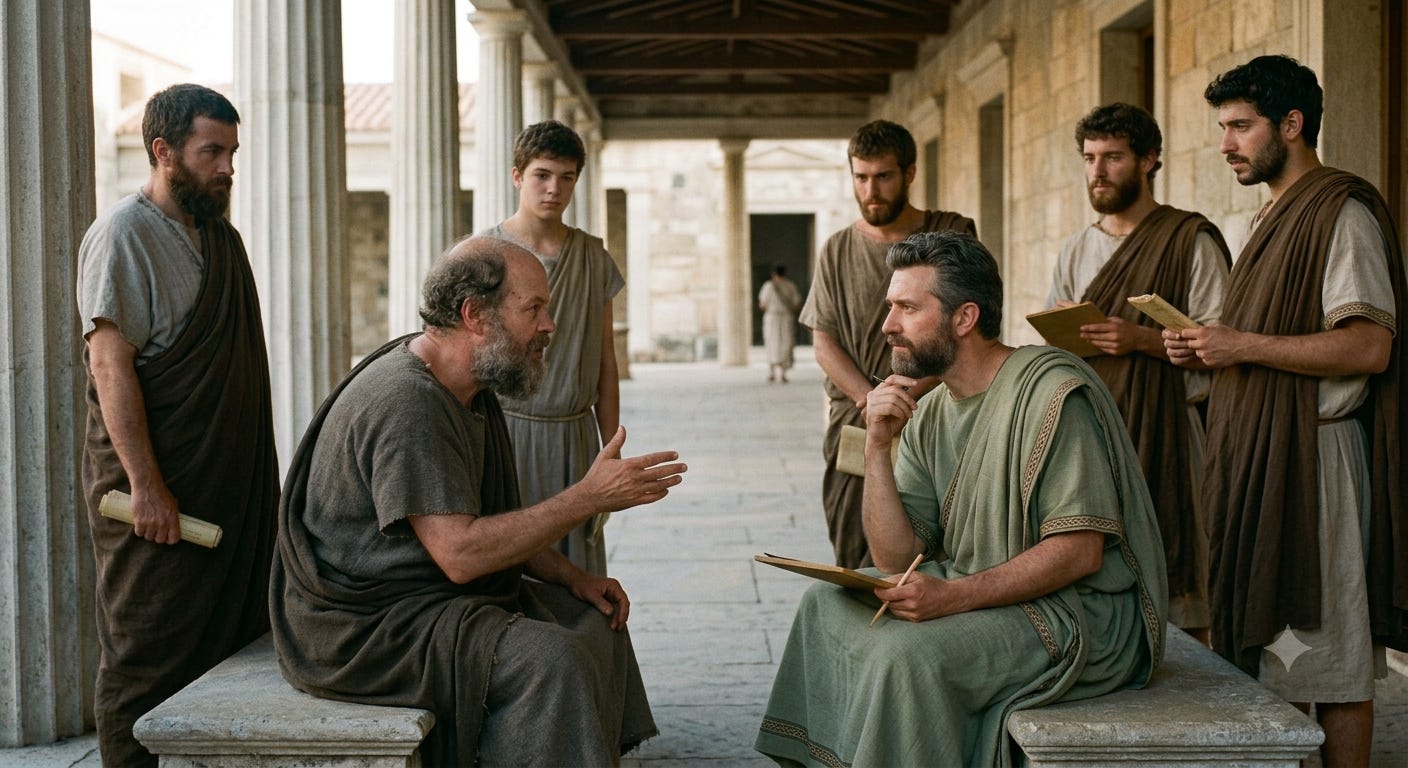
Athens, around 420 BCE, at least in dramatic time. The city is rich, its political class richer, and a good deal of that money is being spent on education. The Greek word for that, scholē, also meant something like “learned discussion,” and it is the ancestor of our own “school,” though I wish that our modern schools truly were places of genuine discussion. But that’s a different story. Into this elite education market walks Hippias of Elis (c. 470–395 BCE), a man who has done very well out of it, and who is about to be asked a simple question he cannot answer.
The question, explored in the Platonic dialogue known as the Hippias Major, is: what is to kalon? In his translation, Robin Waterfield renders it “fineness,” which is ungainly in English but better than the alternatives. “Beauty” is too narrow, “nobility” too moralizing. It should be noted that the Hippias Major is usually coupled with another, shorter dialogue, known as Hippias Minor (more on it in a future post), even though, beyond a shared dramatic date, the only thing the two have in common is that the famous Sophist Hippias is the target of Socrates’s sarcasm.
There are at least two reasons to read this dialogue. The first is that the Hippias Major is arguably the best handbook we have on what Socrates thought a definition had to do: hold across time, apply to every instance, and – the interesting constraint – never come apart from the good. The second reason is more subtle and intriguing: fineness is referred to in ways that led some scholars to wonder whether the dialogue is testimony to the beginnings of Plato’s metaphysics, specifically his famous theory of Forms.
Indeed, the Hippias Major is considered by some scholars to belong to the fuzzy borderline between early and middle Platonic dialogues, which means that we begin to see a transition from what the historical Socrates might have thought and said toward what the mature Plato has to say as a philosopher in his own right.
In order to understand the broader context of the Hippias Major it is useful to recall that a major objective Plato had in mind was to distinguish Socrates from the Sophists, a confusion he believed was a major factor in the conviction and execution of his teacher and friend.
The Sophists were very popular among the Athenian elite, and highly paid, as they claimed to be able to teach how to speak, which was a very useful skill for a politician in a democracy. Plato’s disdain for the Sophists stems from the fact that he thinks they adopted the wrong values. Accordingly, Hippias is represented as being very much concerned with money and very little with truth. The basic charge is that the Sophists taught rhetoric, which Plato associates with the appearance of truth, as opposed to philosophy, which is the quest for truth that leads to wisdom.
Plato also objected to the sort of politician the Sophists catered to: he thought that a good politician isn’t someone who can manipulate the crowd with pretty words, but someone who cultivates virtue. The debate about the importance of rhetoric vs philosophy in politics has not abated since, with major participants including everyone from Cicero to Machiavelli to the modern realpolitik crowd.
The Hippias Major is one of several Platonic dialogues that portray Socrates in search of a satisfying definition for a particular concept, and there’s nothing unusual about it in this respect. The basic idea is that it makes no sense to teach something of which one does not understand the meaning, as the Sophists allegedly do. The central concept, to kalon, is essentially untranslatable into English, but Waterfield’s choice of fineness, or what is fine, is probably as close as it gets. It is important to note, however, that the term has an aesthetic quality to it, and it’s interesting that the Greeks thought that a fine argument, for instance, is also a beautiful one.
At the beginning of the dialogue Hippias doesn’t even seem to get what Socrates is asking when he begins his search for a good definition of to kalon, as his first response is “gold,” which misses the target entirely. Following Socrates’s customary nudging, Hippias eventually provides a better suggestion: fineness is health, wealth, honor, a long life, a fine burial for one’s parents and, in due course, one from one’s own children – basically the catalogue of externals that Homer’s world had taken as the shape of a life gone well. These are the very values that Plato seeks to overthrow, replacing the quest for externals with an inner quest for virtue. In this sense, he and Socrates were subversive revolutionaries!
After Hippias’s attempts, Socrates puts forth three more definitions, attributed to an unnamed interlocutor: fineness is appropriateness, benefit, or aesthetic pleasure. After all this, the dialogue ends in the usual aporia, or impasse.
As Waterfield points out, one reason to think this is a transitional dialogue is because at some point fineness is said to be “something” (287c), an “actual entity” (287c-d), and a “form” (289d), which raises the suspicion that we are now in the presence of a mix of Socratic interest in definitions for reasons of practical wisdom and Plato’s interest in metaphysics, which later will reach maturity in his famous theory of the Forms. Along similar lines, Waterfield reminds us that in several places in the dialogue (e.g., 289d, 294c, and 303a) we are told that fineness is something that is present in fine things, which does sound like a metaphysical theory of the kind that Socrates was not known to articulate, but which became characteristic of later Platonic philosophy.
Why is Plato so interested in to kalon? Because if one understands what fineness is then one is in a position to tell what sort of things are truly fine, which in turn underlies one’s choices in life and, more generally, the pursuit of wisdom. Sure enough, at 296c-d the dialogue tells us in no uncertain terms that the notion that fineness may be harmful is to be rejected in favor of the conclusion that it is beneficial. Fineness therefore leads to the good, and according to Socrates only something that is itself good can lead to good. Moreover, goodness is the very goal of life, which means that asking a superficially odd question about fineness brings the interlocutors to conclusions about what makes a human life worth living.
It would be easy to read the ending as a failure. Socrates and Hippias part company with no definition in hand, and the reader who came for an answer leaves without one. But notice what survives the wreckage: every candidate definition is tested against a constraint that is never itself abandoned, that is, that whatever fineness turns out to be, it cannot be something that harms us. Notice, too, the order in which Socrates’s three proposals arrive: appropriateness, then benefit, and only last the aesthetic one, pleasure through sight and hearing. That the aesthetic candidate is placed at the end and then rejected is not an accident of composition, it is likely Plato’s way of telling us that to kalon cannot be reduced to what merely looks or sounds good, however strong the pull of the Greek usage in that direction. The dialogue fails to define fineness while quietly ruling out a whole class of wrong answers, which is a great deal more than nothing.
And so we end more or less where we began, with Hippias. He arrived able to list fine things and he leaves able to list fine things, untouched by the discovery that he cannot say what makes any of them fine. That is precisely Plato’s indictment of the Sophists in miniature: a man who traffics in the appearance of knowledge, who is paid handsomely for it, and who has no idea what he doesn’t know. The charge has aged well: we are not short of people who can speak fluently and at length about what makes a life go well – the health, the wealth, the honors, the good name – and who have never once been asked, or asked themselves, to give an account of why those things belong on the list. Socrates asked, that the question went unanswered is less interesting than the fact that it can still be put, and that most of us, pressed on it, would do about as well as Hippias.
Well, I got questions--but no answer.
How do kalon and telos connect. I sense a similarity.