
Cynic satire
So-called Menippean satire was invented by an ancient Cynic philosopher. And it has influenced us for millennia
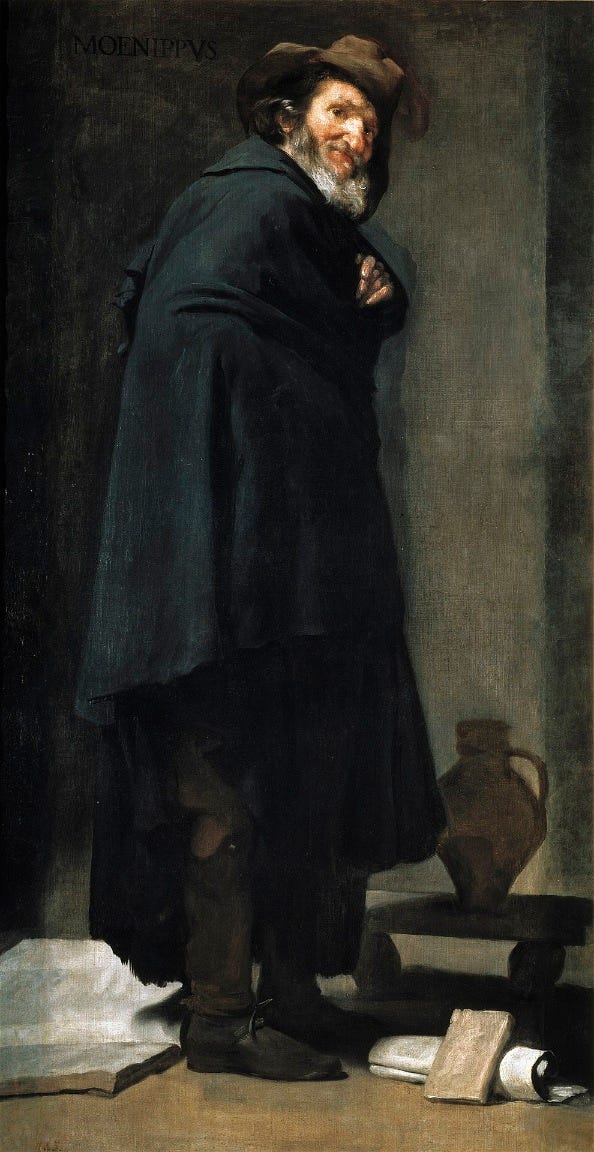
Menippus of Gadara (modern day Jordan) was a slave. He was also a Cynic philosopher and a satirist. We don’t know much about him, except the fact that he was a Greek, likely of Phoenician descent. When he obtained his freedom he moved to Thebes. Even more unfortunately, all his works have been lost. Which makes Menippus one of the most influential figures of antiquity you probably never heard of.
According to the commentator Diogenes Laertius, Menippus wrote books with titles like Necromancy, Letters Artificially Composed as If by the Gods, and The Birth of Epicurus, among others. They were works of satire of a new kind, which is nowadays referred to as Menippean.
Menippus’ writings always addressed serious topics, but delighted in humor and ridicule. He attacked both the Stoics and the Epicureans and was known among his contemporaries as “the earnest jester.” Classical Menippean satire has been described as a mix of allegory, picaresque writing, and satirical commentary, often using mythological burlesque to criticize the myths of traditional culture — in line with Cynic philosophy in general.
This was an innovation over the previous style of satire as embodied by Aristophanes. In his comedies we find personal attacks on specific individuals, as in his (in)famous critique of Socrates in The Clouds. Menippus, by contrast, wished to criticize ideas, and he made his characters to be representative of such ideas. As Northrop Frye writes in “The Anatomy of Criticism,” the targets of Menippean satire are “pedants, bigots, cranks, parvenus, virtuosi, enthusiasts, rapacious and incompetent professional men of all kinds.”
Menippus influenced so many writers, both in antiquity and more recently, that it is astounding that his name is not a household one. Among ancient figures we find Lucian of Samosata (125–180 CE), who satirized religion, superstition, and even belief in the paranormal. Before him, Menippus had a direct impact on Marcus Terentius Varro (116–27 BCE), who actually refers to his own works as saturae menippeae. In the same vein we then find Apuleius’ (124–170 CE) Metamorphoses, better known as The Golden Ass; the work of Horace (65–8 BCE); and that of Julian the Apostate (331–363 CE).
Perhaps the best known Menippean satire of the Greco-Roman period is by the Stoic philosopher Seneca the Younger (4 BCE — 65 CE): the Apocolocyntosis, or The pumpkinification of (the Divine) Claudius, a harsh critique not just of the emperor who had sent Seneca into exile, but more broadly of the ancient Romans' bizarre custom to “make” dead emperors into gods. The title itself is a satirical pun, being based on the word apotheosis, which referred to the process of transforming someone into a god.
Mikhai Bakhtin, in his Problems of Dostoevsky’s Poetics, suggests that the Menippean tradition didn’t end in antiquity, but influenced a surprising number of modern writers. Bakhtin provides an in-depth characterization of the genre, which he sees as distinguished by a heightened comic element, the freedom to operate in the realm of the fantastic, a description of the action that adopts a view from above (kataskopia), a tendency to experiment with psychopathological states of mind (from daydreaming to split personality, and even madness), and characters discovering possibilities that diverge from those apparently preordained for them by society.
Menippean satire — ancient and modern — always features a central philosophical idea that gets tested under extraordinary circumstances. Think of it as thought experiments on steroids, but funny. No room for boring and rigid formal arguments here. Some of the modern authors that have been influenced by Menippus the Cynic include Erasmus (in his In Praise of Folly, 1509), François Rabelais (Gargantua and Pantagruel, 1564), Miguel Cervantes (Novelas Ejemplares, 1612), Jonathan Swift (Gulliver’s Travels, 1726), Voltaire (Candide, 1759), Lewis Carroll (Alice in Wonderland, 1865), Fyodor Dostoevsky (Bobok, 1873), Aldous Huxley (Point Counter Point, 1928), James Joyce (Finnegans Wake, 1939), all the way to Terry Gilliam (Brazil, 1985). It’s a darn impressive group!
