
Beyond the Inner Citadel
Ludwig Edelstein and the limits of self-help philosophy

What do we mean when we call someone “Stoic”? In common usage, the adjective conjures someone who grits their teeth, endures in silence, and doesn’t complain. A kind of austere, inward resilience. The last chapter of a little known book by classical scholar Ludwig Edelstein is, among other things, an elegant and systematic refutation of that reductive image.
Edelstein is not as well known among people interested in Stoicism as, say, Pierre Hadot, the author of The Inner Citadel, a landmark volume on the philosophies of Epictetus and Marcus Aurelius. And yet, Edelstein’s The Meaning of Stoicism, originally published in 1966, is a fundamental contribution not only to understanding ancient Stoicism, but to the ongoing project of updating the philosophy for the 21st century.
Edelstein was a German-American historian of science and classical scholar, widely regarded as one of the most influential figures in the study of ancient medicine and the Hippocratic Corpus in the 20th century. Born in Berlin in 1902, he pursued his education in Germany, earning his doctorate from the University of Heidelberg in 1929. His early academic work focused on Greek philosophy and the history of medicine. However, his career was dramatically altered by the rise of the Nazi regime. As a Jewish scholar, he was forced to leave Germany in 1933. He initially moved to Turkey, where he taught at the University of Istanbul, before emigrating to the United States in 1935.
In the U.S., Edelstein joined the faculty of Johns Hopkins University in Baltimore, where he spent the remainder of his career. He became a leading figure in the Department of the History of Medicine. His scholarship was characterized by rigorous philological analysis combined with deep philosophical insight. His most famous and enduring contribution is his work on the Hippocratic Oath. Edelstein argued that the oath was not merely a medical contract but a reflection of the Pythagorean philosophical tradition. For instance, he posited that the strict ethical prohibitions in the oath (such as against surgery and abortion) were specific to a Pythagorean sect of physicians rather than the broader medical community of the time.
Edelstein also made significant contributions to the understanding of Epicureanism and the history of Greek philosophy. He was known for his ability to reconstruct the intellectual contexts of ancient texts, moving beyond mere textual criticism to explore the lived philosophical and ethical realities of the ancient world. He passed away in 1965, leaving behind a legacy of meticulous scholarship that fundamentally shaped how modern scholars understand the intersection of medicine, ethics, and philosophy in antiquity.
My colleague Christian Vassallo, at the University of Turin, has recently curated the Italian translation of Edelstein’s The Meaning of Stoicism, and has invited me to contribute to a panel discussion about the book. The volume is comprised of four chapters: The Stoic Sage, The Stoic conception of Nature, Stoic self-criticism (on the divergent opinions of the Middle Stoa), and The Stoic way of life. I chose to focus my commentary on the last chapter, and what follows is a slightly edited version of my presentation.
“The Stoic Way of Life” strikes me as the richest chapter in Edelstein’s book in terms of implications for those of us interested not only in the history of ancient Stoicism but in the now decades-long project of updating it for our own time.
I’ll organize my discussion in three movements: first, the core of Edelstein’s argument; then, three specific areas where the chapter illuminates a potential that today’s popular Stoicism tends to overlook; and finally, two limitations that Edelstein himself identifies – which are, in my view, perhaps the most valuable part of the chapter, because they tell us where the work of renewal still needs to go.
Let’s start with the central thesis. Edelstein states it clearly in the opening pages: the Stoic ars vivendi is not the construction of a harmonious personality folded in on itself. That, if anything, is the Epicurean version – or, in part, the Platonic one. Stoicism is something different and more demanding: it is the capacity to act well within the web of one’s relationships, to be fully oneself through engagement with others.
To make this concrete, Edelstein invokes the celebrated image of the concentric circles of Hierocles, a Stoic philosopher of the second century: at the center is the self, then the family, then friends, then one’s city, then humanity as a whole. This is not a rigid hierarchy, a checklist of priorities to be applied mechanically. It is a map of progressive responsibilities, a way of visualizing how moral commitment must expand from the private to the public, from the intimate to the universal.
This image carries a direct implication for contemporary debate. Stoicism is today one of the most popular philosophies of life, thanks to the work of scholars like Pierre Hadot in France, Larry Becker in the United States, and John Sellars in England, as well as popularizers like Donald Robertson and the Modern Stoicism group. But this popularity comes at a cost: in the version that circulates through self-help books and podcasts, Stoicism becomes almost exclusively a philosophy of emotional management, of controlling one’s inner space. There is a great deal of talk about the dichotomy between what is “up to us” and what is not; there is very little talk – almost none, in fact – about engagement with the political community, with the kosmopolis.
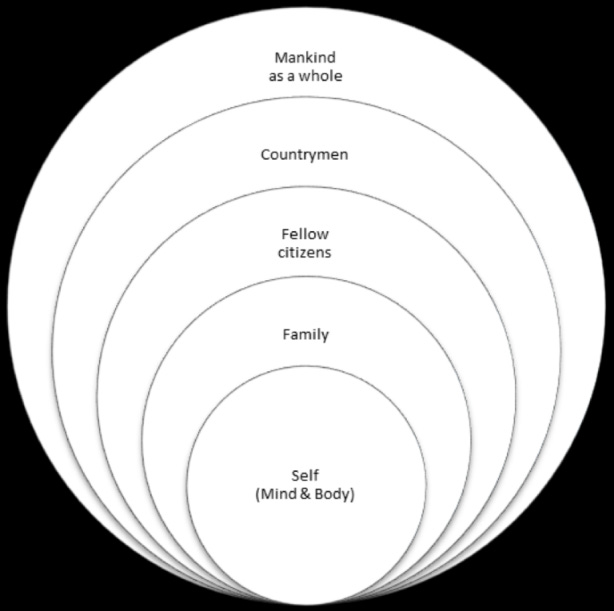
Edelstein reminds us that this reading is legitimate but seriously incomplete. The Stoic sage cannot conceive of himself as a private individual. There is an irreducible tension in ancient philosophy between emotional self-governance and social commitment, and the ancient texts treated both as inseparable.
There are three specific areas where Edelstein’s chapter shows that the Stoics anticipated problems that remain wide open and, I would add, problems of burning contemporary relevance.
The first concerns equality and dignity in relationships. Edelstein emphasizes that the Stoic positions here were radical in the ancient context: full equality between husband and wife, rights of children against absolute patriarchal authority, and – most uncomfortable of all – the recognition of the slave as a full human being. Seneca and Epictetus are explicit and courageous on this last point. What interests us today is not this as historical curiosity, but as evidence that Stoic ethics already contained the conceptual resources to extend the moral circle far beyond the boundaries of classical citizenship. Stoic cosmopolitanism was not rhetoric: it had practical implications, even if ancient society was unable, or unwilling, to draw all the consequences.
The second area is professional ethics, a point that popular literature almost entirely neglects. The Stoics do not simply rehabilitate manual labor, already a significant move, in direct polemic with Aristotle. They do something more systematic: they construct the first professional ethics of antiquity. The physician has specific duties as a physician; the judge has obligations that derive from his function as a judge. From here, as Edelstein notes, comes the Christian idea of vocation. But the contemporary implication is even more pressing: the distinction between personal morality and professional responsibility is one of the central ethical problems of our time. Think of medicine, finance, politics, and, I would add today, artificial intelligence. Ancient Stoicism offers us a conceptual grammar for addressing these problems that has not yet exhausted its usefulness.
The third area is the relationship between natural law and positive law. Chrysippus formulated a principle that would become a cornerstone of Roman law: summum ius summa iniuria – the height of law is the height of injustice. That is, the rigid, mechanical application of positive (human) law can produce grave injustices. The idea is that human law is just only insofar as it accords with natural law; when it departs from it, it is an aberration, not an authority. This is the same argument we find, in its modern variations, in Enlightenment reformers, in the jurists of the postwar Nuremberg trials, in the civil rights movements of the 1960s and 70s, and in many contemporary legal struggles for rights. Stoicism provides the grammar for this discussion better than any other ancient philosophical system. It is a legacy we have not yet finished claiming.
We come now to the part of the chapter that I find most useful for anyone who wants to take the renewal project seriously. Edelstein is not an apologist, so he closes his essay with a lucid critique of Stoicism, and this intellectual honesty is exactly what we need.
The first limitation concerns the overvaluation of the individual and the undervaluation of institutions. Pascal had already seen the problem: the Stoics know the greatness of man but not his weakness. If all moral weight falls on the individual, if virtue is exclusively a matter of personal character, there is a risk of ignoring how the collective moral climate, social structures, and institutions profoundly shape the choices each of us makes. Plato was right about this, and so was Cicero, when he criticized his Stoic friend and colleague Cato the Younger for being too focused on individual virtue and too little attentive to the architecture of republican institutions.
A contemporary update of Stoicism must therefore integrate a theory of institutions. It is not enough to form the character of the physician if the hospital she works in systematically incentivizes the wrong behaviors. It is not enough to educate the virtuous citizen if the political structures reward corruption. Individual virtue is necessary but not sufficient.
The second limitation concerns the problem of reason misused (see also here). The Stoics believed that reason, properly cultivated, naturally leads to the good. But Edelstein, with Schopenhauer in the background, notes that reason can be instrumentalized for bad ends. A cold reason, devoid of compassion, stripped of moral emotions, can become the tool of crimes committed with methodical detachment. It is a serious objection that contemporary Stoicism cannot afford to ignore.
How, then, do we articulate the relationship between rationality and moral passions? This is a discussion that leads directly to the confrontation between Epictetus and Aristotle on the role of emotions in the ethical life. And it is precisely why both Cicero and Seneca spoke not of “reason” in the abstract, but of right reason, a reason, that is, informed by an ethical orientation, rooted in the foundational Stoic concept of “living according to nature.” Stoic rationality is never pure calculation: it is rationality in dialogue with values.
Edelstein wrote in the 1950s, but his diagnoses sound strangely familiar. Atomistic individualism dressed up as autonomy, professional irresponsibility hidden behind compliance with formal rules, nationalisms that ignore – or openly deride – the idea of a universal human community.
The chapter I have tried to present here shows that ancient Stoicism was already, in its fullest and most demanding form, a project for the reform of our entire shared life, not just our inner life. An update faithful to this vision is more ambitious, and probably more uncomfortable, than Stoicism reduced to an emotional toolkit for stress management. But it is also, I think, more necessary.
I’ll close with the words with which Edelstein ends the chapter, paraphrasing the British poet and cultural critic Matthew Arnold with evident approval: Stoicism is in a way the creed of all men who love freedom.
Not an exhausted ideology, then, but a resource very much still alive, provided we restore to it the complexity and nuance it deserves.
Yes! 🖖 Spock is definitely not strict utilitarian. There is a lot of virtue ethics in that Human/ Vulcan mind.
This is really interesting, I will read that book, what a great find.. I agree that what we (mostly) have as an idea of Stoicism is a facsimile of what it was intended to be, and that more work on institutions would be beneficial.
I disagree with the critique of the primacy of reason in Stoicism. Those tired arguments from the 50s and 60s (a response to Nazi "rationalism" and capitalism) are the reason Western philosophy has been consumed by postmodern relativism and the abyss of identity politics.
Stoic reason is rooted in Oikeosis, it has a fundamental grounding in beneficence. Anybody who uses reason for bad or purely indfifferent ends are not using reason, they're just using shallow calculation. This is axiomatic in Stoicism because nobody does bad willingly. To break with the primacy of reason is to break Stoicism altogether. Stoicism's monistic conception of the soul - that emotions arise from beliefs - rests on that primacy. Emotions are epiphenomena. Are there paradoxes in that idea? Yes. But they can be solved and explained.
Thanks for the read, and for provoking all the above thoughts.